How AI is Revolutionizing Crop Yields
How artificial intelligence, satellite imagery, sensors, computer vision, and predictive analytics are helping farmers make better decisions, use resources more efficiently, and improve crop productivity.


Article Contents
- •Agriculture Is Entering The Intelligence Era
- •From Guesswork To Data-Driven Farming
- •How AI Predicts Crop Yields
- •AI-Powered Crop Monitoring
- •Detecting Diseases Before They Spread
- •Smarter Irrigation And Water Management
- •Precision Fertilization And Nutrient Management
- •AI For Pest And Weed Management
- •Weather And Climate Risk Prediction
- •Drones, Satellites, And Computer Vision
- •AI-Powered Farm Equipment And Automation
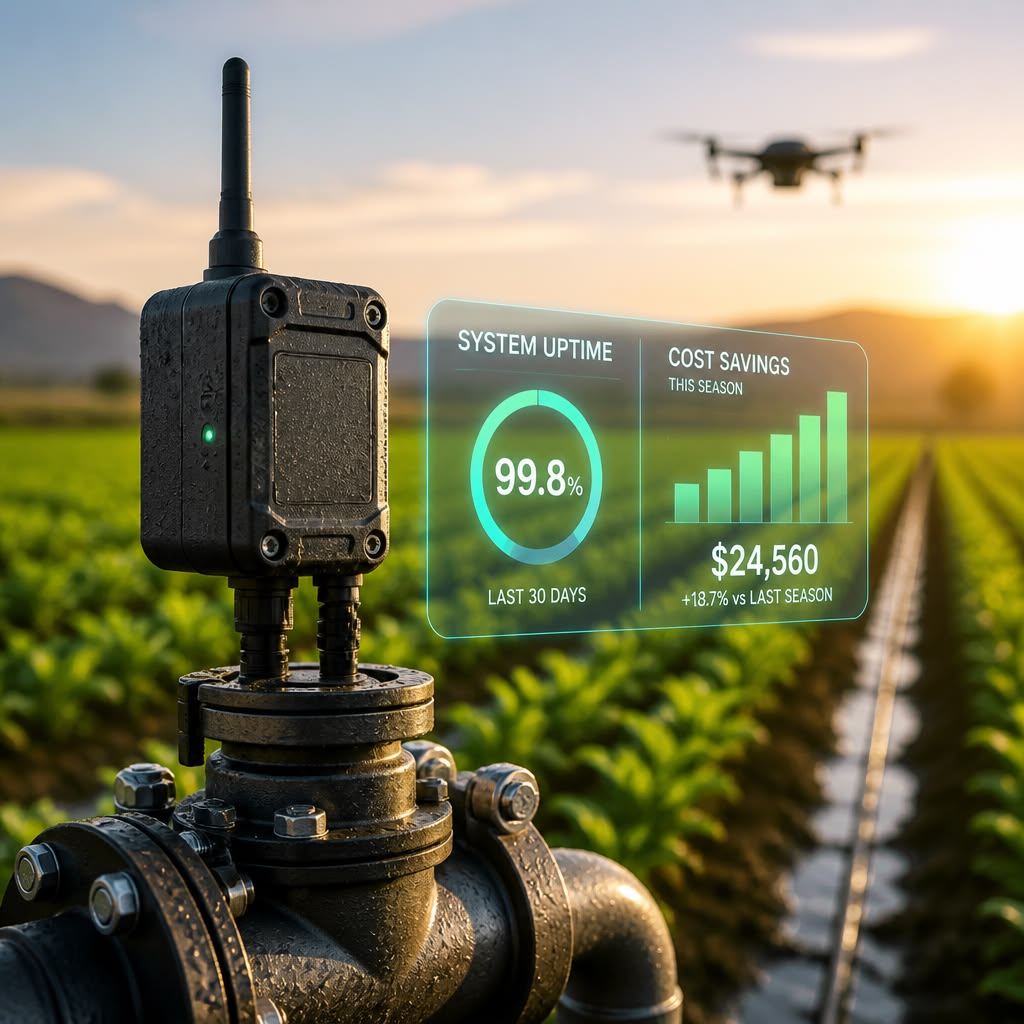
- •The Role Of IoT And Real-Time Farm Data
- •What AI Means For Farmers
- •Challenges To AI Adoption
- •The Future Of AI-Powered Agriculture
- •A Practical AI Adoption Roadmap For Farms
- •Making The Call
- •Final Takeaway
How artificial intelligence, satellite imagery, sensors, computer vision, and predictive analytics are helping farmers make better decisions, use resources more efficiently, and improve crop productivity.
Agriculture Is Entering The Intelligence Era
For thousands of years, farming has depended on experience, observation, weather patterns, and increasingly sophisticated machinery.
Today, another layer is being added:
Intelligence.
Artificial intelligence is changing agriculture by helping farmers turn enormous amounts of information into practical decisions.
Weather conditions, soil characteristics, satellite imagery, crop images, irrigation data, historical yields, pest activity, and field sensors can all contribute to a more detailed picture of what is happening on a farm.
Instead of asking only:
How did my field perform last year?
farmers can increasingly ask:
What is happening in my field right now, what is likely to happen next, and what should I do about it?
That shift is at the heart of precision agriculture.
Recent research has identified AI applications across crop-yield prediction, irrigation, soil mapping, pest and disease detection, and crop-quality assessment.
AI is not replacing agricultural knowledge.
It is helping farmers use that knowledge with better information and better timing.
From Guesswork To Data-Driven Farming
Farming has always involved uncertainty.
A farmer makes decisions about:
- When to plant
- How much seed to use
- When to irrigate
- How much fertilizer to apply
- When to spray
- When to harvest
- Which fields require attention
But conditions can vary significantly even within the same farm.
One part of a field may have enough moisture while another is dry.
One section may show signs of disease while another remains healthy.
One area may have nutrient deficiencies that are invisible from a distance.
AI can help identify these differences.
A modern precision agriculture system can combine:
Satellite Data + Drone Images + Soil Sensors + Weather Data + Farm History + Crop Images + Machine Learning
to create a more detailed view of field conditions.
The goal is not simply to collect more data.
The goal is to turn that data into actionable decisions.
How AI Predicts Crop Yields
One of the most valuable applications of AI in agriculture is yield prediction.
Yield prediction means estimating how much crop a field is likely to produce before harvest.
Traditional estimates may depend heavily on historical averages, field observations, crop sampling, and weather expectations.
Machine learning can analyze many variables simultaneously.
For example:
Yield Prediction = Weather + Soil + Crop Health + Historical Yield + Irrigation + Management + Satellite Data
Machine-learning models can identify relationships between these variables and historical crop outcomes.
A system may learn that a particular combination of:
- Temperature
- Rainfall
- Soil moisture
- Crop growth
- Nutrient availability
is associated with a certain yield range.
Research published through USDA's Agricultural Research Service in August 2025 examined corn-yield prediction using multi-temporal unmanned aerial system data and machine learning, demonstrating the growing role of aerial data in crop forecasting.
Why Yield Prediction Matters
Accurate yield forecasts can help farmers and agricultural businesses make better decisions about:
- Harvest planning
- Storage
- Transportation
- Labor
- Inventory
- Commodity sales
- Supply-chain planning
- Financial planning
The value is therefore larger than simply knowing the expected number of tons or bushels.
Better forecasts can improve decisions across the entire agricultural supply chain.
AI-Powered Crop Monitoring
Farmers cannot physically inspect every plant in a large field every day.
This is where computer vision becomes powerful.
Cameras mounted on:
- Drones
- Tractors
- Robots
- Smartphones
- Fixed monitoring systems
can capture thousands or millions of images.
AI models can analyze these images to identify patterns that humans may miss.
For example, computer vision can help detect:
- Changes in plant color
- Leaf damage
- Disease symptoms
- Weed growth
- Crop density
- Plant stress
- Fruit size
- Crop maturity
Instead of treating an entire field as one unit, farmers can increasingly manage it as a collection of smaller zones.
This is one of the core ideas behind precision agriculture:
Apply the right treatment to the right area at the right time.
Detecting Diseases Before They Spread
Crop disease can spread quickly.
By the time symptoms become obvious across an entire field, significant damage may already have occurred.
AI-powered image analysis can help identify disease symptoms earlier.
A farmer can capture an image of a plant using a smartphone or use cameras mounted on agricultural equipment.
A computer-vision model can analyze characteristics such as:
- Leaf patterns
- Color changes
- Spots
- Texture
- Shape
- Visible damage
and classify potential disease or stress conditions.
This can support earlier intervention.
However, AI diagnosis should be treated as a decision-support tool rather than an unquestionable authority.
Image quality, crop variety, lighting conditions, geography, and disease similarity can affect model performance.
The strongest systems therefore combine AI predictions with agronomic expertise and field verification.
Smarter Irrigation And Water Management
Water is one of agriculture's most important resources.
Too little water can reduce crop growth.
Too much water can waste resources, increase disease risk, and damage crops.
AI can help optimize irrigation by combining:
- Soil moisture
- Weather forecasts
- Temperature
- Humidity
- Crop growth stage
- Historical irrigation
- Evapotranspiration estimates
- Field location
Instead of applying the same amount of water everywhere, a precision system can identify areas that need more or less irrigation.
The workflow can look like:
Sensor Data → AI Analysis → Soil Moisture Prediction → Irrigation Recommendation → Automated/Manual Action
AI research in agriculture increasingly focuses on precision irrigation alongside yield prediction, pest management, and soil analysis.
The benefit is not simply saving water.
Better irrigation can also help maintain more consistent growing conditions.
Precision Fertilization And Nutrient Management
Applying fertilizer uniformly across a field assumes that every part of the field has identical nutrient requirements.
In reality, soil conditions can vary.
AI can combine:
- Soil test results
- Crop health imagery
- Historical yield maps
- Soil composition
- Crop requirements
- Weather information
to identify areas that may require different nutrient treatments.
This can support variable-rate application, where fertilizer quantities are adjusted based on field conditions.
The objective is straightforward:
Apply enough nutrients to support healthy growth without unnecessary application.
This can potentially improve resource efficiency while reducing avoidable input costs.
AI For Pest And Weed Management
Pests and weeds compete directly with crops for resources.
Traditional approaches may involve treating large areas even when only certain sections have a problem.
AI and computer vision can support more targeted management.
A camera system mounted on agricultural machinery can identify differences between crops and weeds.
The system can then support targeted spraying or mechanical removal.
This is particularly interesting because AI can move agriculture from:
"Treat the entire field."
toward:
"Identify the problem and treat the affected area."
Research on AI in precision agriculture identifies pest detection, weed control, and smart spraying as important application areas.
That could improve both economic efficiency and resource use.
Weather And Climate Risk Prediction
Weather can make or break a growing season.
Rainfall, temperature, drought, heatwaves, storms, and changing seasonal patterns can significantly affect agricultural production.
AI can combine historical and real-time information to support forecasting and risk assessment.
For example, a farm decision system could estimate:
Probability of heavy rainfall → Soil moisture impact → Disease risk → Irrigation adjustment
Or:
Heatwave forecast → Crop stress risk → Irrigation recommendation → Field prioritization
The objective is not to predict the weather better than meteorological systems in every situation.
It is to translate weather information into crop-specific decisions.
Climate variability is one reason yield prediction and AI-based agricultural decision support are receiving increasing attention.
Drones, Satellites, And Computer Vision
One of the most important changes in agriculture is the ability to observe fields from above.
Satellites can provide large-scale monitoring.
Drones can provide higher-resolution imagery over specific areas.
Ground equipment and sensors can provide even more localized information.
Together, these technologies create multiple layers of observation.
Satellite
Best for: Large-area monitoring and regular field observations.
Drone
Best for: High-resolution inspection and targeted analysis.
Ground Sensors
Best for: Soil, moisture, temperature, and local environmental conditions.
Smartphone Cameras
Best for: Low-cost field-level crop and disease observations.
AI acts as the intelligence layer that interprets these different sources.
Research has shown that AI systems can process data from UAVs, ground vehicles, and satellites for applications including yield prediction and crop monitoring.
This creates a powerful concept:
See the field from above, understand it at ground level, and combine both perspectives through AI.
AI-Powered Farm Equipment And Automation
AI is also moving beyond analysis.
It is increasingly being integrated into agricultural machinery.
Modern agricultural equipment can use sensors, cameras, GPS, and machine learning to assist with:
- Navigation
- Seeding
- Spraying
- Weed detection
- Harvesting
- Crop monitoring
- Equipment optimization
USDA research projects are exploring AI-based systems for real-time crop yield, quality, maturity, and harvest-time assessment, along with autonomous platforms and robotic harvesting.
This is important because agriculture faces a practical labor challenge.
Tasks such as weeding, harvesting, monitoring, and sorting can be repetitive and time-consuming.
Automation can take over parts of these workflows while farmers remain responsible for higher-level decisions.
The Role Of IoT And Real-Time Farm Data
AI becomes significantly more useful when it has access to current information.
This is where the Internet of Things, or IoT, becomes important.
Sensors can continuously collect information about:
- Soil moisture
- Temperature
- Humidity
- Water levels
- Crop conditions
- Equipment status
- Weather conditions
The data can be sent to a central platform where AI models analyze it.
A simplified architecture looks like:
Sensors, Drones, Satellites → Data Platform → AI / ML Models → Prediction Recommendation Alert → Farmer Decision → Field Operation
This creates a continuous feedback loop:
Observe → Analyze → Decide → Act → Measure → Learn
That is the foundation of intelligent farming.
What AI Means For Farmers
AI should not be presented as technology that replaces farmers.
Agriculture is highly local.
A model trained on one crop, climate, soil type, or geography may not perform equally well somewhere else.
The farmer's experience remains critical.
The strongest model is therefore:
AI + Farmer Knowledge
rather than:
AI instead of Farmer
AI can handle large-scale data processing and pattern detection.
Farmers provide local context.
For example, an AI system may identify unusual crop stress, but an experienced farmer may know that the field was recently treated, flooded, or affected by a local condition that is not represented in the available data.
The best systems combine both forms of intelligence.
Challenges To AI Adoption
AI has enormous potential, but it is not a magic solution.
Several challenges must be addressed.
Data Quality
AI predictions depend heavily on the quality and relevance of the data.
Poor sensor readings or incomplete historical records can produce unreliable recommendations.
Connectivity
Many agricultural areas have limited or inconsistent internet connectivity.
Systems that depend entirely on cloud services may struggle in these environments.
Cost
Sensors, drones, connectivity, software, and AI systems can require significant investment.
This can be especially challenging for small and marginal farmers.
Model Generalization
An AI model that works well in one region may perform differently under another climate, soil condition, crop variety, or farming practice.
Farmer Training
Technology only creates value when farmers can understand and use it.
Simple interfaces, local-language support, training, and practical recommendations are therefore important.
Trust
Farmers need to understand why a system is making a recommendation.
This makes explainable and transparent AI increasingly important.
These challenges are particularly important for small-scale agriculture, where affordability and accessibility can determine whether an AI system moves beyond a research demonstration into real-world use.
The Future Of AI-Powered Agriculture
The next phase of agricultural AI will likely involve multiple technologies working together.
Imagine a farm where:
Satellites identify changes across large fields.
Drones inspect suspicious areas.
Sensors measure soil and environmental conditions.
AI combines the information.
Computer vision identifies crop stress or disease.
Predictive models estimate future yield.
Robotics perform selected field operations.
Farm management software turns everything into actionable recommendations.
This is more than automation.
It is a move toward continuous, data-driven farm management.
Research directions are also expanding toward multimodal AI, edge deployment, and models that can adapt across agricultural environments.
In the long term, this could make agricultural systems more responsive:
Detect → Predict → Recommend → Act → Learn
The important development is that AI will increasingly move from simply telling farmers what happened to helping them anticipate what may happen next.
A Practical AI Adoption Roadmap For Farms
Farmers and agricultural businesses do not need to digitize everything at once.
A practical approach is to start with one measurable problem.
Step 1: Identify The Biggest Pain Point
Is it:
- Water usage?
- Crop disease?
- Yield uncertainty?
- Pest management?
- Labor?
- Fertilizer cost?
Start there.
Step 2: Collect Useful Data
Combine the data that already exists with only the additional sensors or tools that are actually needed.
Step 3: Run A Small Pilot
Test AI on one crop, field, or operational process.
Step 4: Compare Against The Existing Method
Measure:
Yield + Cost + Water + Inputs + Labor + Accuracy
Step 5: Expand Only After Evidence
If the system produces measurable benefits, expand it gradually.
This reduces financial risk and helps farmers understand what actually works for their conditions.
Making The Call
AI is not going to make every farm fully autonomous overnight.
And it does not need to.
The immediate opportunity is much more practical:
Make better decisions earlier.
Know where the crop is under stress.
Know where water is needed.
Know where pests may be developing.
Estimate yield before harvest.
Apply inputs more precisely.
Identify problems before they become expensive.
That is where AI can create real value.
Agriculture has always depended on information—from the appearance of clouds to the condition of the soil.
AI is changing the scale and speed at which that information can be understood.
Final Takeaway
The future of farming is not simply about producing more.
It is about producing more intelligently.
AI can help farmers combine:
Data + Experience + Prediction + Precision + Automation
to make better decisions across the growing cycle.
The most promising model is not:
AI replaces the farmer.
It is:
AI gives the farmer a better view of the field, better predictions, and better tools for making decisions.
As satellite imagery, drones, IoT sensors, computer vision, robotics, and machine learning continue to converge, farms can become increasingly responsive to what is happening at the plant, field, and regional level.
The future agricultural workflow may look like:
Sense → Understand → Predict → Act → Measure → Improve
The technology will continue to evolve.
But the fundamental objective remains simple:
Grow healthier crops, use resources more intelligently, reduce avoidable losses, and help farmers make better decisions.
That is the real promise of AI in agriculture.
Frequently Asked Questions
Need a product built?
We build custom software, mobile apps, and web platforms for startups and enterprises.



Their team became an extension of ours — within months they'd rebuilt our entire product experience from the ground up.