Securing Supply Chains with Predictive Analytics
How AI, predictive analytics, satellite imagery, IoT sensors, and real-time farm data are helping agriculture move from reacting to disruptions toward anticipating them.


Article Contents
- •Why Agricultural Supply Chains Need Better Prediction
- •From Farm-Level Data to Supply-Chain Intelligence
- •How Predictive Analytics Secures the Farm-to-Market Journey
- •Predicting Crop Yields Before Harvest
- •Forecasting Demand and Supply
- •Detecting Crop Risks Before They Become Supply Problems
- •Smarter Irrigation and Resource Planning
- •Predicting Weather and Climate Disruptions
- •Using Satellites, Drones, and IoT for Supply-Chain Visibility
- •Reducing Post-Harvest Losses
- •Building an AI-Powered Agricultural Control Tower
- •Where Farmers and AI Work Together
- •Challenges to Predictive Agriculture
- •A Practical Adoption Roadmap
- •The Future of Resilient Agricultural Supply Chains
- •Making the Call
- •Final Takeaway
How AI, predictive analytics, satellite imagery, IoT sensors, and real-time farm data are helping agriculture move from reacting to disruptions toward anticipating them.
Why Agricultural Supply Chains Need Better Prediction
Agriculture does not begin at the supermarket.
It begins months earlier—with a seed in the soil, a weather forecast, irrigation decisions, crop health, harvesting, storage, transportation, and eventually the movement of food into markets.
Every step depends on the one before it.
That makes agricultural supply chains particularly sensitive to uncertainty.
A drought can reduce production.
Heavy rainfall can delay harvesting.
A disease outbreak can damage a crop.
A pest infestation can spread across fields.
Unexpected demand can create shortages.
And even when the crop is successfully harvested, poor storage or transportation can turn a good harvest into a supply problem.
The difficult part is that many of these problems are not visible when they begin.
By the time a shortage reaches the market, the original cause may have started weeks or months earlier.
This is where predictive analytics becomes interesting.
Instead of asking only:
"What happened to the crop?"
agricultural businesses can increasingly ask:
"What is likely to happen next, and how can we prepare before it affects the supply chain?"
That shift—from reacting to predicting—could become one of the most important changes in modern agricultural operations.
Research and current agricultural AI applications already span yield prediction, crop monitoring, irrigation, soil analysis, pest detection, weather-risk assessment, and supply-chain planning.
From Farm-Level Data to Supply-Chain Intelligence
For a long time, agricultural decisions were based primarily on experience, field observations, historical records, and weather expectations.
Those remain valuable.
But today's farms can generate far more information.
A modern agricultural operation may have access to:
- Satellite imagery
- Drone photography
- Soil sensors
- Weather data
- Irrigation records
- Crop-health images
- Historical yield information
- Equipment data
- Market information
- Farm-management systems
The challenge is no longer simply collecting information.
The challenge is connecting it.
Consider a simple example.
A soil sensor detects declining moisture.
Weather forecasts indicate limited rainfall.
Satellite imagery shows early signs of crop stress.
The crop is approaching a sensitive growth stage.
Individually, these signals are useful.
Together, they may indicate a potential yield reduction.
Predictive analytics can connect those signals and estimate what they could mean for production.
That prediction can then travel beyond the field:
Field Risk → Yield Forecast → Harvest Planning → Storage → Transportation → Market Supply
This is where agricultural intelligence becomes supply-chain intelligence.
How Predictive Analytics Secures the Farm-to-Market Journey
A resilient agricultural supply chain needs visibility across several stages.
Farm → Crop Production → Yield Prediction → Harvest → Storage & Processing → Transportation → Markets → Consumers
Predictive analytics can introduce intelligence at each stage.
For example:
Before harvest: Estimate expected yield.
During production: Detect crop stress, disease, pests, or water shortages.
Before harvesting: Estimate crop maturity and prepare labor and equipment.
After harvesting: Forecast storage and transportation requirements.
Before market delivery: Identify potential supply shortages or demand changes.
The result is a more connected operating model:
Sense → Predict → Prepare → Act
Instead of discovering problems after they disrupt the supply chain, businesses can begin preparing while there is still time to respond.
Predicting Crop Yields Before Harvest
Yield prediction sits at the center of agricultural supply-chain planning.
If you do not know approximately how much crop will be available, everything downstream becomes harder to plan.
How much storage will be required?
How many trucks will be needed?
How much labor should be scheduled?
How much product can be committed to buyers?
How much inventory might be available?
Traditional forecasting can rely heavily on historical averages and field observations.
Predictive analytics can combine many more variables:
Yield Prediction = Weather + Soil + Crop Health + Irrigation + Historical Yield + Satellite Data + Management
Machine-learning models can identify relationships between these variables and previous crop outcomes.
For example, a system might detect that a combination of:
- High temperatures
- Low soil moisture
- Reduced vegetation health
- Below-average rainfall
has historically been associated with lower yields.
That does not mean the model knows the future with certainty.
It means the business gets an earlier estimate of risk.
And that estimate can be extremely valuable.
Better yield forecasts can influence:
- Harvest planning
- Storage capacity
- Transportation
- Labor
- Inventory
- Commodity sales
- Supply-chain planning
- Financial planning
The prediction therefore has value far beyond the farm itself.
Forecasting Demand and Supply
Agricultural supply chains have another difficult problem:
Supply and demand do not always move together.
A region may experience a strong harvest while demand is low.
Another region may face weak production while demand increases.
Predictive analytics can help businesses compare expected production with expected demand.
A simplified model could look like:
Expected Crop Supply + Market Demand + Historical Patterns + Seasonal Signals → Supply Forecast
This can help identify potential situations such as:
Expected Surplus
Production is likely to exceed expected demand.
Businesses may need additional storage or alternative markets.
Expected Shortage
Production is likely to fall below expected demand.
Businesses may need to secure alternative sources earlier.
Uncertain Supply
Weather, crop health, or other variables create a wide range of possible outcomes.
Businesses can prepare multiple scenarios instead of relying on one forecast.
This is an important change in thinking.
Instead of:
"We expect 10,000 tons."
a better question may be:
"What is our most likely supply, what is the downside scenario, and when will we know which scenario is becoming more likely?"
That is a much more useful question for supply-chain planning.
Detecting Crop Risks Before They Become Supply Problems
A supply-chain disruption often starts as a field-level problem.
A plant becomes stressed.
A disease appears.
A pest population increases.
Soil moisture drops.
But these early signals may not immediately look like supply-chain risks.
AI can help connect the dots.
Computer vision systems can analyze crop images for:
- Leaf discoloration
- Disease symptoms
- Plant stress
- Weed growth
- Crop density
- Leaf damage
- Fruit size
- Crop maturity
This creates an important possibility:
Detect the agricultural problem before it becomes an agricultural supply problem.
For example:
Crop Stress → AI Detection → Yield Risk → Supply Forecast Adjustment → Procurement / Storage / Logistics Response
The earlier the signal appears, the more options the business has.
That is the real advantage of prediction.
Smarter Irrigation and Resource Planning
Water management is not only a farming issue.
It can also become a supply-chain issue.
If water shortages reduce crop growth, the consequences may eventually reach production volumes, harvest schedules, prices, and market availability.
AI can combine:
- Soil moisture
- Weather forecasts
- Temperature
- Humidity
- Crop growth stage
- Historical irrigation
- Evapotranspiration estimates
- Field location
A system can then estimate future soil conditions and recommend irrigation adjustments.
The workflow might look like:
Sensor Data → AI Analysis → Soil-Moisture Prediction → Irrigation Recommendation → Field Action
This becomes particularly powerful when connected to production forecasting.
If a crop is entering a sensitive growth period and predicted water stress is increasing, the system can flag the potential impact before yield losses become obvious.
That creates a direct connection between:
Resource Management → Crop Health → Yield → Supply
Predicting Weather and Climate Disruptions
Agriculture has always been exposed to weather.
But modern supply chains need to understand more than whether it will rain tomorrow.
They need to understand:
What could this weather event mean for production?
Rainfall can affect soil moisture.
Extreme heat can increase crop stress.
Storms can delay harvesting.
High humidity can increase disease risk.
Drought can reduce production.
Predictive systems can combine weather information with crop and field conditions to translate environmental changes into agricultural risk.
For example:
Heavy Rain Forecast
→ Soil moisture increase → Harvesting difficulty → Disease risk → Logistics disruption → Possible delivery delay
Or:
Heatwave Forecast
→ Crop stress → Increased irrigation demand → Potential yield reduction → Lower expected supply
This is an important distinction.
The goal is not simply to predict weather.
The goal is to predict what the weather could mean for the crop and the supply chain.
Using Satellites, Drones, and IoT for Supply-Chain Visibility
One of the biggest advantages of modern agricultural technology is the ability to observe farms at multiple levels.
Satellites
Provide broad, repeated observations across large agricultural areas.
Best for: Large-scale crop monitoring and identifying changes over time.
Drones
Provide high-resolution imagery over specific fields or problem areas.
Best for: Detailed crop inspection and targeted analysis.
Ground Sensors
Measure local conditions such as soil moisture, temperature, and humidity.
Best for: Real-time field-level information.
Smartphone Cameras
Provide accessible crop images directly from the field.
Best for: Low-cost observations and potential disease or stress identification.
These sources can work together.
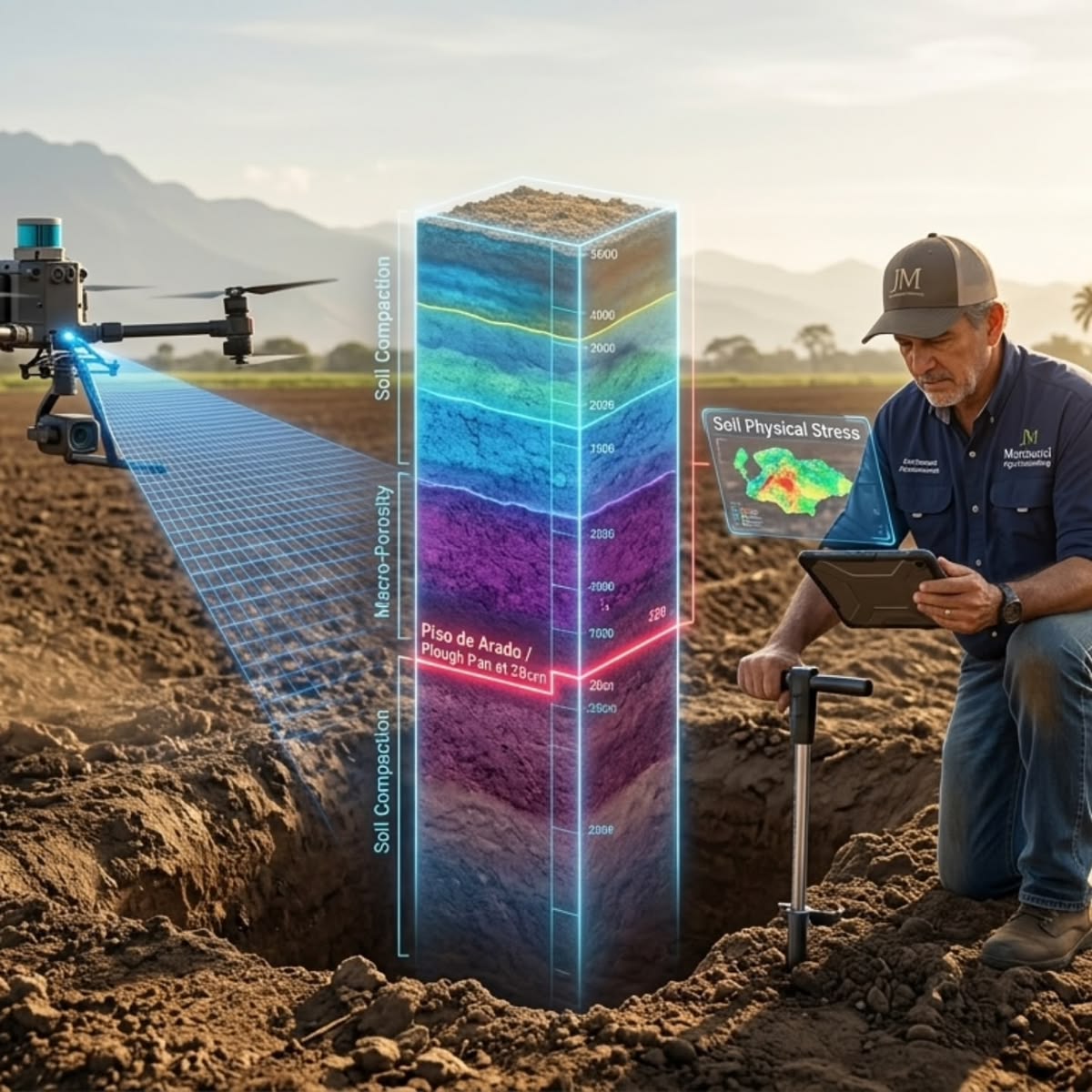
The agriculture report describes this as combining satellite data, drone imagery, ground sensors, crop images, weather data, farm history, and machine learning into a more detailed view of field conditions.
The bigger idea is:
See the farm from above. Understand it at ground level. Then use AI to connect the signals.
That creates a much stronger foundation for supply-chain forecasting.
Reducing Post-Harvest Losses
Predictive analytics should not stop when crops leave the field.
The post-harvest stage is another critical part of agricultural supply chains.
A successful harvest still needs to be:
Stored → Processed → Transported → Delivered
At each stage, timing matters.
Yield forecasts can help businesses prepare storage capacity before harvest.
Crop maturity predictions can help coordinate labor and harvesting equipment.
Expected production volumes can help logistics teams plan transportation.
Market forecasts can help determine where inventory should be sent.
This creates a more coordinated chain:
Yield Forecast → Harvest Planning → Storage Planning → Transportation Planning → Market Allocation
Instead of treating harvesting, storage, and transportation as separate activities, predictive analytics can connect them into one planning process.
Building an AI-Powered Agricultural Control Tower
Imagine opening a dashboard and seeing the entire agricultural operation through one intelligent view.
Not just:
"What happened?"
But:
"What is changing?"
"What is at risk?"
"What could happen next?"
"What should we prioritize?"
A simplified architecture could look like this:
Agricultural Data (Satellites, Sensors, Drones) → Data Platform → AI / ML Layer → Yield Forecast / Risk Detection / Demand Forecast → Supply-Chain Insights → Business Decisions → Field / Market Action
This creates a continuous intelligence loop:
Observe → Analyze → Predict → Decide → Act → Learn
That is the foundation of a more resilient agricultural supply chain.
Where Farmers and AI Work Together
It is tempting to describe AI as replacing agricultural expertise.
That misses the point.
Agriculture is highly local.
A model may identify unusual crop stress, but a farmer may know that the field was recently treated, flooded, planted with a different variety, or affected by a local condition that the model cannot see.
AI is good at processing enormous amounts of information.
Farmers are good at understanding context.
The strongest combination is therefore:
AI + Farmer Knowledge
not:
AI Instead of Farmer
The same principle applies to supply-chain managers.
AI can identify a potential disruption.
People decide how the business should respond.
The best systems make human decision-makers faster, better informed, and more proactive.
Challenges to Predictive Agriculture
Predictive analytics has enormous potential, but implementation is not automatic.
Data Quality
Poor sensor readings, incomplete farm records, or inconsistent historical data can produce unreliable predictions.
Connectivity
Agricultural areas may have limited connectivity, making cloud-dependent systems difficult to operate continuously.
Cost
Sensors, drones, connectivity, AI platforms, and farm-management systems can require significant investment.
This can be especially important for smaller agricultural operations.
Model Generalization
A model trained for one crop, geography, climate, or farming method may not perform equally well elsewhere.
Trust
Farmers and supply-chain teams need to understand why the system is making a prediction.
Human Verification
AI predictions should support decisions rather than blindly replace field verification and agricultural expertise.
The technology is powerful.
But its value depends on whether the people using it can trust it and act on it.
A Practical Adoption Roadmap
Agricultural businesses do not need to transform their entire operation overnight.
A smarter approach is to start with one problem that has a measurable business impact.
Step 1: Find the Biggest Supply-Chain Risk
Ask:
- Is yield too difficult to forecast?
- Are harvest schedules unpredictable?
- Are crop diseases causing unexpected losses?
- Is water availability affecting production?
- Are transportation plans frequently changing?
- Are market shortages difficult to anticipate?
Start with one.
Step 2: Connect the Relevant Data
Bring together only the information required to solve the problem.
For example:
Yield Prediction
→ Weather + Soil + Satellite + Crop Health + Historical Yield
Step 3: Run a Pilot
Test the model on:
- One crop
- One field
- One region
- One supplier network
- Or one harvest cycle
Step 4: Measure the Impact
Track meaningful outcomes:
Forecast Accuracy + Yield + Water Usage + Input Costs + Waste + Inventory + Response Time
Step 5: Connect Predictions to Decisions
A prediction without an action is just another dashboard metric.
For example:
High Yield Risk → Review Harvest Plan
High Disease Risk → Field Inspection
Expected Supply Shortage → Secure Alternative Supply
Expected Surplus → Plan Additional Storage or Markets
Step 6: Scale What Works
Once the system demonstrates measurable value, expand it.
This reduces risk while making the technology easier for teams to adopt.
The Future of Resilient Agricultural Supply Chains
The next generation of agricultural systems will likely connect technologies that previously operated independently.
Imagine a farm where:
Satellites monitor large-scale field conditions.
Drones inspect areas that need closer attention.
IoT sensors measure soil and environmental conditions.
Computer vision identifies crop stress.
AI models estimate yield.
Weather intelligence identifies upcoming risks.
Predictive analytics estimates supply-chain impact.
Farm-management platforms turn those predictions into actions.
This is more than digital farming.
It is the beginning of a predictive agricultural supply chain.
The workflow could eventually look like:
Sense → Understand → Predict → Assess Supply Impact → Recommend → Act → Measure → Learn
The important shift is that AI moves the conversation from:
"What happened to our crop?"
to:
"What is likely to happen next, and what can we do now?"
That is where predictive analytics becomes genuinely valuable.
Making the Call
Agricultural supply chains will never eliminate uncertainty.
Weather will remain unpredictable.
Markets will change.
Pests will evolve.
Transportation will face disruptions.
Demand will move.
The goal is not to create a system that predicts everything perfectly.
The goal is to create a system that gives farmers and agricultural businesses more time to respond.
Know when crop health is deteriorating.
Know when water stress is increasing.
Know when yield expectations are changing.
Know when harvest capacity may become a bottleneck.
Know when supply could fall below demand.
And, most importantly, know these things before they become expensive problems.
That is the real promise of predictive analytics in agriculture.
Final Takeaway
The future of agricultural supply chains is not simply about producing more food.
It is about building a system that can see earlier, predict better, and respond faster.
Predictive analytics can connect:
Farm Data + AI + Weather + IoT + Satellite Imagery + Crop Intelligence + Supply-Chain Planning
into one continuous decision-making system.
The most valuable model is not:
AI replaces farmers.
It is:
AI gives farmers and agricultural businesses a clearer view of what is happening, a better understanding of what may happen next, and more time to make the right decision.
As satellite imagery, drones, sensors, computer vision, machine learning, and automation continue to converge, agricultural supply chains can become increasingly proactive rather than reactive.
The future workflow may look simple:
Sense → Understand → Predict → Prepare → Act → Improve
And that is ultimately what a resilient agricultural supply chain should do:
Turn uncertainty into visibility, predictions into decisions, and early signals into better outcomes.
Frequently Asked Questions
Need a product built?
We build custom software, mobile apps, and web platforms for startups and enterprises.



Their team became an extension of ours — within months they'd rebuilt our entire product experience from the ground up.