
Neutralizing the N+1 Problem With DataLoader
A practical guide to eliminating inefficient database access in GraphQL applications using DataLoader—covering batching, caching, resolver design, scalability, observability, and the architectural decisions that matter when APIs grow.
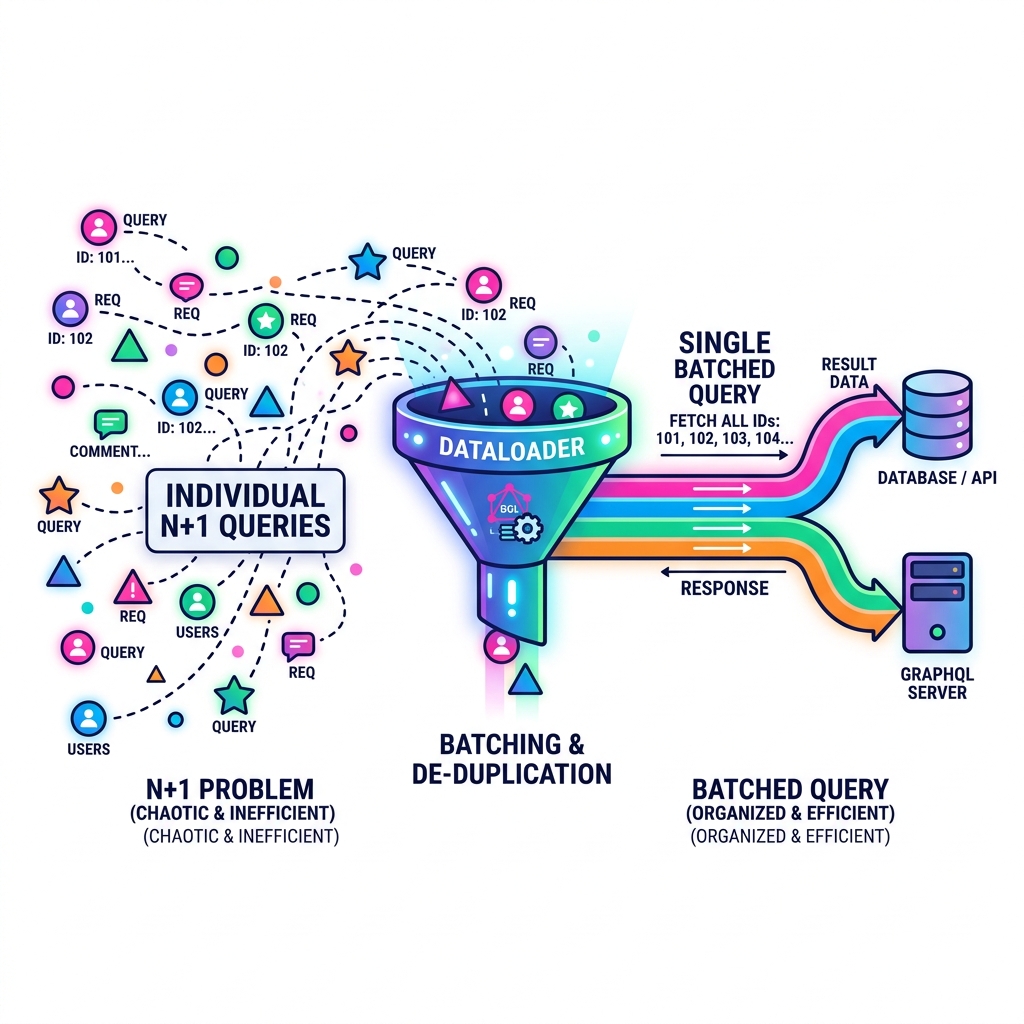


Article Contents
- •What Is the N+1 Problem?
- •Why N+1 Becomes a Serious Production Issue
- •Understanding DataLoader
- •How Batching Changes the Query Pattern
- •Request-Scoped Caching
- •Designing DataLoader Correctly
- •DataLoader With GraphQL Resolvers
- •Avoiding the "One Loader for Everything" Trap
- •DataLoader and Database Performance
- •Handling Errors and Missing Records
- •DataLoader Beyond SQL Databases
- •Observability and Production Monitoring
- •Common DataLoader Mistakes
- •A Practical Implementation Strategy
- •When DataLoader Is Not Enough
- •The Future of Efficient GraphQL APIs
- •Making the Call
- •Final Takeaway
A practical guide to eliminating inefficient database access in GraphQL applications using DataLoader—covering batching, caching, resolver design, scalability, observability, and the architectural decisions that matter when APIs grow.
What Is the N+1 Problem?
The N+1 problem is one of the most common performance issues in data-heavy APIs, particularly GraphQL applications.
Imagine a GraphQL query that requests 100 users and each user's organization:
Query Users
    ↓
100 Users
    ↓
Fetch Organization for User 1
Fetch Organization for User 2
Fetch Organization for User 3
...
Fetch Organization for User 100
Instead of making one query for users and one query for organizations, the application may execute:
1 query
   +
100 queries
   =
101 database queries
That is the N+1 problem.
At small scale, it may not be obvious.
At production scale, it can become a major bottleneck.
Why N+1 Becomes a Serious Production Issue
Suppose an API returns 50 products.
Each product needs its associated category.
A naïve resolver might execute:
SELECT * FROM products;

SELECT * FROM categories WHERE id = 1;
SELECT * FROM categories WHERE id = 2;
SELECT * FROM categories WHERE id = 3;
...
SELECT * FROM categories WHERE id = 50;
The application has transformed a simple request into dozens of database round trips.
The problem becomes worse when relationships are nested.
For example:
Users
 └── Orders
      └── Products
           └── Categories
A seemingly simple GraphQL request can trigger a cascade of queries.
The result can be:
Higher database load
Higher network latency
Connection pool pressure
Slower API responses
Poor scalability
Unpredictable performance
This is why N+1 should be treated as an architectural concern rather than merely a query optimization issue.
Understanding DataLoader
DataLoader is a pattern and commonly used utility for batching and caching data requests.
The basic idea is simple.
Instead of executing:
load(1)
load(2)
load(3)
load(4)
and immediately querying the database four times, DataLoader can collect those requests and execute one batched operation:
load(1)
load(2)
load(3)
load(4)
      ↓
Batch
      ↓
SELECT ...
WHERE id IN (1, 2, 3, 4)
The architecture changes from:
Resolver
 ├── Database
 ├── Database
 ├── Database
 └── Database
to:
Resolvers
    │
    ├── load(1)
    ├── load(2)
    ├── load(3)
    └── load(4)
          │
          ▼
      DataLoader
          │
          ▼
     Batch Function
          │
          ▼
       Database
That is the core mechanism behind DataLoader.
How Batching Changes the Query Pattern
Consider a GraphQL query:
query {
  posts {
    id
    title
    author {
      id
      name
    }
  }
}
Suppose there are 100 posts.
Without batching:
Fetch posts
   ↓
Fetch author 1
Fetch author 2
Fetch author 3
...
Fetch author 100
With DataLoader:
Fetch posts
      ↓
Author IDs
      ↓
[12, 19, 27, 31, ...]
      ↓
One Batch Operation
      ↓
Fetch matching authors
The database workload can move from:
101 queries
to something closer to:
2 queries
The exact number depends on the application, database, resolver behavior, and batching boundaries.
The important improvement is that multiple logical requests are combined into fewer physical data operations.
Request-Scoped Caching
DataLoader provides another important optimization: caching.
Suppose two parts of the same GraphQL request need the same user:
Resolver A
   ↓
load(user123)

Resolver B
   ↓
load(user123)
A request-scoped DataLoader can avoid fetching the same record twice.
Conceptually:
First request
   ↓
Fetch user123
   ↓
Cache

Second request
   ↓
user123
   ↓
Cache hit
This is especially useful in GraphQL because the same object can appear through different paths in a single query.
But there is an important rule:
DataLoader caching should generally be scoped to the request, not treated as a permanent application-wide cache.
Why?
Because long-lived caches introduce difficult questions around:
Stale data
Memory growth
Invalidation
User-specific authorization
Request-scoped caching keeps the caching boundary much easier to reason about.
Designing DataLoader Correctly
A DataLoader batch function typically receives a collection of keys:
[1, 2, 3, 4, 5]
It then returns results corresponding to those keys.
Conceptually:
const userLoader = new DataLoader(async (userIds) => {
  const users = await getUsersByIds(userIds);

  return userIds.map(id =>
    users.find(user => user.id === id)
  );
});
The important detail is that the result must correspond correctly to the input keys.
If the input is:
[5, 2, 9]
the output must preserve that logical ordering:
[user5, user2, user9]
even if the database returns:
[user2, user5, user9]
The batch function therefore needs to map database results back to the requested keys.
This sounds small, but incorrect ordering can create extremely subtle application bugs.
DataLoader With GraphQL Resolvers
DataLoader works particularly well with GraphQL because GraphQL resolves fields independently.
A resolver might look conceptually like:
const resolvers = {
  Post: {
    author: (post, args, context) => {
      return context.loaders.user.load(post.authorId);
    }
  }
};
Each resolver asks for the data it needs.
DataLoader collects those requests and batches them.
The flow becomes:
GraphQL Query
     ↓
Resolve Posts
     ↓
Resolve Authors
     ↓
DataLoader
     ↓
Batch IDs
     ↓
Database
     ↓
Map Results
     ↓
GraphQL Response
This lets resolvers remain relatively simple while moving batching behavior into a reusable data-access layer.
Avoiding the "One Loader for Everything" Trap
Once teams discover DataLoader, there is a temptation to create loaders for every possible operation.
That can lead to an overly complicated data-access layer.
Instead, create loaders around meaningful access patterns.
Examples:
userByIdLoader
productByIdLoader
organizationByIdLoader
ordersByCustomerLoader
Each loader should have a clear purpose.
Avoid creating loaders that hide completely unrelated database behavior behind generic interfaces.
A good DataLoader should make the access pattern more obvious, not less.
DataLoader and Database Performance
DataLoader reduces the number of application-level requests to the database.
But batching alone does not guarantee a fast query.
For example:
DataLoader
    ↓
SELECT ...
WHERE id IN (...)
If the underlying database column is not properly indexed, the query can still be expensive.
You therefore need both:
Efficient Batching
       +
Efficient Database Queries
       +
Appropriate Indexes
       =
Better Performance
Consider:
Indexes
Query plans
Connection pooling
Result sizes
Pagination
Database capacity
Read replicas where appropriate
DataLoader is one layer of optimization, not the entire performance strategy.
Handling Errors and Missing Records
A batch request can contain keys that do not exist.
For example:
Requested:
[101, 102, 103, 104]

Found:
101
103
104
The loader must correctly represent the missing value for `102`.
Likewise, if one key fails while others succeed, the system should define how errors are returned.
A robust DataLoader implementation should distinguish between:
Record exists
Record does not exist
Database failure
Authorization failure
These are not the same thing.
Treating every missing record as a system error can create unnecessary failures.
Treating every database failure as "not found" can hide serious production problems.
DataLoader Beyond SQL Databases
DataLoader is not limited to relational databases.
It can batch requests against:
REST APIs
GraphQL services
Redis
NoSQL databases
Internal services
External APIs
Imagine a GraphQL API that needs customer information from another service.
Without batching:
GraphQL
  ↓
Customer Service × 100
With a compatible batch endpoint:
GraphQL
   ↓
DataLoader
   ↓
Customer Service
   ↓
Batch Request
This can reduce network overhead as well as database work.
However, the downstream system must support an efficient batch access pattern.
If it does not, DataLoader may simply move the bottleneck somewhere else.
Observability and Production Monitoring
Performance improvements should be measurable.
Track metrics such as:
Batch size
Batch frequency
Cache hit rate
Database query count
Resolver latency
Database latency
API response time
Error rate
A useful flow is:
GraphQL Request
      ↓
Resolver Metrics
      ↓
DataLoader Metrics
      ↓
Database Metrics
      ↓
Performance Analysis
For example, if the average DataLoader batch size is consistently `1`, you may not actually be benefiting from batching.
That could indicate:
Resolver execution patterns
Incorrect loader lifecycle
Unexpected asynchronous behavior
Query structure
Loader placement
Observability helps reveal these issues.
Common DataLoader Mistakes
Creating a Global Loader
A globally shared cache can create stale-data and authorization problems.
Prefer request-scoped loaders in typical GraphQL server architectures.
Using DataLoader as a General Cache
DataLoader is primarily designed around batching and request-level caching.
It should not automatically replace a dedicated caching architecture.
Returning Results in the Wrong Order
The batch result must correspond correctly to the requested keys.
Ignoring Missing Records
The loader should explicitly handle keys that have no matching record.
Batching Without Indexes
A single large query can still be slow if the database cannot efficiently access the requested records.
Batching Huge Numbers of Keys
Extremely large batches can create their own problems.
Database parameter limits, query size, memory, and latency should be considered.
Hiding Business Logic Inside Loaders
DataLoaders should primarily coordinate data retrieval.
Business rules should remain in appropriate application or domain layers.
Assuming Every N+1 Problem Requires DataLoader
Sometimes the correct solution is:
A SQL join
A better database query
A precomputed view
A different GraphQL schema
A different API boundary
DataLoader is a tool—not a universal solution.
A Practical Implementation Strategy
Step 1: Identify N+1 Queries
Use:
Database logs
APM
Tracing
GraphQL resolver metrics
Find endpoints generating excessive queries.
Step 2: Identify the Access Pattern
For example:
Post
  ↓
authorId
  ↓
User
This is a natural candidate for batching.
Step 3: Create a Request-Scoped Loader
Create the loader as part of the request context.
Request
  ↓
Context
  ├── userLoader
  ├── productLoader
  └── organizationLoader
Step 4: Replace Individual Fetches
Change:
fetchUser(post.authorId)
to:
userLoader.load(post.authorId)
Step 5: Implement Efficient Batch Queries
Prefer a real batch operation:
WHERE id IN (...)
rather than simply running the original query repeatedly inside the batch function.
Step 6: Verify Result Mapping
Ensure every requested key receives the correct result.
Step 7: Measure
Compare:
Query count
Latency
Database load
Cache hits
Batch size
before and after the change.
Step 8: Expand Carefully
Apply the pattern to other genuine N+1 hotspots.
Do not automatically add DataLoader everywhere.
When DataLoader Is Not Enough
DataLoader solves a particular class of problem.
It does not automatically solve:
Slow database queries
Poor schema design
Large result sets
Missing indexes
Expensive aggregations
Bad pagination
Over-fetching
Distributed-system latency
For example, if a GraphQL query requests 100,000 records, batching them into one operation may still be a terrible idea.
You may instead need:
Pagination
   +
Filtering
   +
Selective Fields
   +
Efficient Queries
Likewise, if the application repeatedly calculates expensive analytics, a precomputed dataset or analytical system may be more appropriate.
Always identify the underlying bottleneck first.
The Future of Efficient GraphQL APIs
Modern GraphQL platforms are increasingly focused on making data access more predictable.
The broader architecture may look like:
                    Client
                      │
                   GraphQL
                      │
              ┌───────┼───────┐
              ▼       ▼       ▼
           Resolver Resolver Resolver
              │       │       │
              └───────┼───────┘
                      ▼
                 Data Layer
                      │
          ┌───────────┼───────────┐
          ▼           ▼           ▼
       Database      Cache      Services
DataLoader remains useful within this architecture because it provides a controlled boundary between field-level resolution and underlying data access.
At the same time, newer API architectures increasingly combine:
Persisted queries
Response caching
Federation
Batch APIs
Query complexity limits
Observability
AI-assisted query analysis
The direction is clear:
GraphQL systems need to become smarter about how logical queries translate into physical data access.
That distinction will become increasingly important as applications expose richer APIs and larger datasets.
Making the Call
Engineering leaders evaluating DataLoader should ask:
Where exactly is the N+1 problem occurring?

Can the underlying data source support efficient batch retrieval?

Would a join or better query solve the problem more simply?

Are loaders scoped correctly to individual requests?

How large can batches become?

Are missing records and errors handled correctly?

How will we measure cache effectiveness and batch performance?

Are we using DataLoader as a batching mechanism or accidentally turning it into an application-wide cache?
Most importantly:
What is the simplest architecture that eliminates the actual bottleneck?
Final Takeaway
The N+1 problem is rarely caused by GraphQL itself.
It usually appears when a flexible field-resolution model meets an inefficient data-access strategy.
DataLoader provides a powerful bridge between those two worlds.
Instead of:
1 Parent Query
      +
N Child Queries
      =
N+1 Operations
you can move toward:
Parent Query
      +
Batched Child Query
      =
Predictable Data Access
The biggest benefits come from:
Batching related requests
Request-scoped caching
Efficient database queries
Correct result mapping
Clear resolver boundaries
Strong observability
But DataLoader should not become a bandage for every database performance issue.
Sometimes a join is better.
Sometimes a different schema is better.
Sometimes pagination is the answer.
Sometimes the database query itself needs optimization.
The goal is not to use DataLoader everywhere. The goal is to make every logical API request translate into an efficient physical data-access pattern.
Start by measuring the N+1 problem.
Batch where batching makes sense.
Keep loaders request-scoped.
Optimize the underlying queries.
Monitor the results.
And resist the temptation to turn a focused performance technique into a universal abstraction.
A fast GraphQL API is not one that makes fewer queries at any cost. It is one that makes the right data-access decisions for the workload—and DataLoader is one of the most effective tools for making those decisions predictable.
Frequently Asked Questions
Need a product built?
We build custom software, mobile apps, and web platforms for startups and enterprises.



Their team became an extension of ours — within months they'd rebuilt our entire product experience from the ground up.