Mastering Change Data Capture With Debezium: Building Real-Time Data Pipelines From Database Changes
Learn how to capture database changes as they happen and stream them to downstream services using Debezium and Kafka.


Article Contents
- •Why Change Data Capture Matters
- •What Is Debezium?
- •How Debezium Works
- •Understanding CDC Events
- •Building a Debezium Architecture
- •Debezium and Kafka
- •Handling Inserts, Updates, and Deletes
- •Designing Reliable CDC Pipelines
- •Avoiding Duplicate and Out-of-Order Events
- •Schema Changes and Data Evolution
- •Monitoring CDC in Production
- •Common Debezium Mistakes
- •A Practical Adoption Strategy
- •The Future of CDC
- •Making the Call
- •Final Takeaway
Modern applications need data to move faster than traditional batch pipelines can manage. Change Data Capture (CDC) provides a different approach: instead of repeatedly querying entire tables, systems capture database changes as they happen and stream them to downstream services. Debezium makes this practical by turning inserts, updates, and deletes from supported databases into structured change events that can power analytics, event-driven applications, data synchronization, and real-time architectures.
Why Change Data Capture Matters
Traditional data integration often relies on scheduled queries:
Database
   ↓
Scheduled Job
   ↓
SELECT Changed Rows
   ↓
Transform
   ↓
Destination
This works, but it has limitations.
The system must repeatedly determine:
What changed since the last run?
As data volumes grow, those queries can become expensive.
There is also an unavoidable delay.
If a job runs every 15 minutes, downstream systems may wait up to 15 minutes before seeing new data.
CDC takes a different approach:
Database Change
      ↓
CDC Capture
      ↓
Event
      ↓
Stream
      ↓
Consumers
Instead of repeatedly asking the database what changed, the system observes the database's change stream and publishes those changes as events.
This makes CDC particularly useful for:
Real-time analytics
Data synchronization
Event-driven applications
Search indexing
Cache updates
Data warehouses
Audit pipelines
What Is Debezium?
Debezium is an open-source distributed platform for Change Data Capture.
Its connectors capture row-level changes from supported databases and convert those changes into events that downstream systems can consume.
The high-level architecture looks like:
Source Database
      ↓
Debezium Connector
      ↓
Change Events
      ↓
Kafka / Streaming Platform
      ↓
Consumers
A database transaction such as:
UPDATE customers
SET email = 'new@example.com'
WHERE id = 42;
can become a structured change event.
Downstream applications no longer need to repeatedly query the `customers` table to discover the change.
They can react to the event.
How Debezium Works
Debezium typically captures changes from the database's transaction log or equivalent change stream rather than repeatedly scanning tables.
The exact mechanism depends on the database.
Conceptually:
Application
    ↓
Database
    ↓
Transaction Log
    ↓
Debezium
    ↓
Change Event
For databases that support transactional logs, this approach has an important advantage:
The CDC system can observe committed database changes without adding a query-based polling loop over the application tables.
This makes CDC efficient for many high-volume workloads.
A simplified pipeline is:
INSERT / UPDATE / DELETE
          ↓
     Transaction Log
          ↓
       Debezium
          ↓
      Serialization
          ↓
     Event Stream
Understanding CDC Events
One of the most important concepts when working with Debezium is understanding the structure of change events.
A change event generally communicates information such as:
Which record changed
What operation occurred
What the record looked like
What it looks like after the change
Where the change occurred in the source stream
For example, conceptually:
{
  "operation": "update",
  "before": {
    "status": "pending"
  },
  "after": {
    "status": "confirmed"
  }
}
An update is therefore more than:
"Customer 42 changed."
The event can contain the information needed by downstream systems to understand the transition.
This makes CDC useful for building reactive systems.
Building a Debezium Architecture
A production CDC platform often looks like:
                 Source Database
                       │
                       ▼
               Debezium Connector
                       │
                       ▼
                Kafka / Stream
                       │
        ┌──────────────┼──────────────┐
        ▼              ▼              ▼
   Data Warehouse    Search         Service
        │              │              │
        └──────────────┼──────────────┘
                       ▼
                    Analytics
The database remains the system of record.
Debezium acts as the bridge between transactional data and downstream consumers.
This creates useful separation:
OLTP Database
     │
     │ Changes
     ▼
CDC Layer
     │
     ├── Analytics
     ├── Search
     ├── Cache
     └── Applications
The transactional system does not need to know every downstream consumer.
Debezium and Kafka
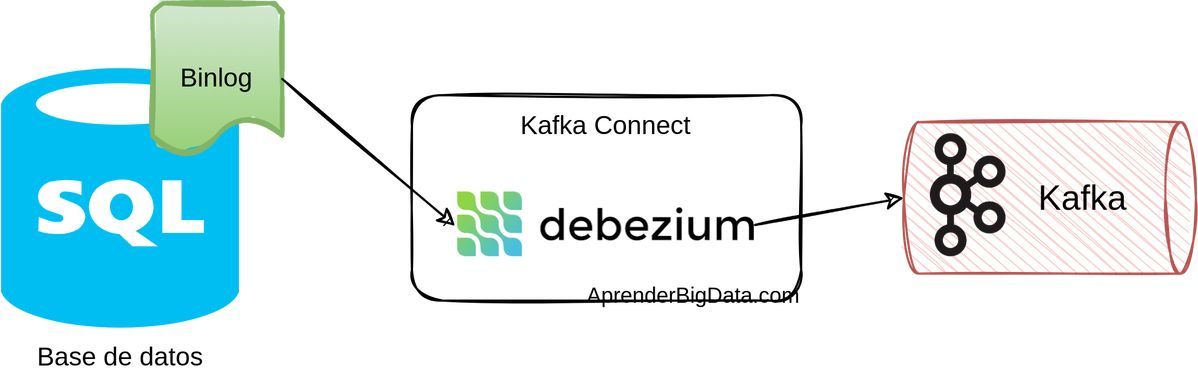
Debezium is commonly used with Apache Kafka and Kafka Connect.
A typical architecture is:
Database
   ↓
Debezium Source Connector
   ↓
Kafka Connect
   ↓
Kafka Topics
   ↓
Consumers
Kafka provides durable event-streaming infrastructure, while Debezium provides the database-change capture capability.
This separation is powerful because multiple consumers can independently subscribe to the same stream.
For example:
Customer Changes
       ↓
   Kafka Topic
       │
 ┌─────┼─────┬────────┐
 ▼     ▼     ▼        ▼
Search Cache Analytics CRM
One database change can therefore drive multiple downstream processes without repeatedly querying the source database.
Handling Inserts, Updates, and Deletes
CDC pipelines need to correctly process all major database operations.
Insert
INSERT
  ↓
CDC Event
  ↓
Create Downstream Record
Update
UPDATE
  ↓
CDC Event
  ↓
Update Downstream Record
Delete
DELETE
  ↓
CDC Event
  ↓
Delete / Tombstone Downstream Record
Deletes deserve special attention.
A downstream system that only processes inserts and updates can become permanently inconsistent with the source database.
For example:
Source
Customer 42 → Deleted

Search Index
Customer 42 → Still Exists
Your CDC consumers need an explicit deletion strategy.
Designing Reliable CDC Pipelines
CDC introduces a new class of distributed-system concerns.
A pipeline can experience:
Network failures
Consumer crashes
Connector restarts
Database outages
Schema changes
Traffic spikes
A reliable architecture should assume these events will happen.
Useful mechanisms include:
Durable event storage
Consumer offsets
Retries
Dead-letter handling
Idempotent processing
Monitoring
The goal is:
Database Change
      ↓
Captured
      ↓
Stored
      ↓
Consumed
      ↓
Processed
Each stage should have a clear recovery strategy.
Avoiding Duplicate and Out-of-Order Events
Distributed systems can produce duplicate processing.
Imagine:
Event A
 ↓
Consumer
 ↓
Process
 ↓
Crash Before Offset Commit
 ↓
Restart
 ↓
Process Event A Again
The downstream operation must be safe to repeat.
This is why idempotency matters.
For example, instead of blindly inserting:
INSERT customer
a consumer may use an upsert-style operation based on a stable record identifier.
The general principle is:
Design consumers so that processing the same event more than once does not corrupt the final state.
Ordering also matters.
If a record changes:
Pending
  ↓
Confirmed
  ↓
Shipped
processing those events in the wrong order can produce an incorrect downstream state.
Partitioning, event metadata, consumer design, and the guarantees of the chosen streaming architecture all need to be considered.
Schema Changes and Data Evolution
Databases evolve.
A table may change from:
customers
 ├── id
 ├── name
 └── email
to:
customers
 ├── id
 ├── name
 ├── email
 └── phone
CDC pipelines need to handle these changes safely.
Schema evolution becomes particularly important when multiple consumers depend on the same event stream.
A useful principle is:
Database schema evolution and event schema evolution should be treated as related but separate concerns.
Consumers should be designed to tolerate compatible changes where possible.
Avoid making every downstream application dependent on an exact database schema at every moment.
Monitoring CDC in Production
A CDC pipeline can fail without the source database appearing unhealthy.
That makes dedicated monitoring essential.
Track metrics such as:
Connector health
Replication lag
Event throughput
Consumer lag
Processing failures
Retry rates
Dead-letter events
Schema errors
A useful monitoring model is:
Database
   ↓
CDC Capture
   ↓
Streaming Platform
   ↓
Consumers
   ↓
Monitoring
One particularly valuable metric is CDC lag.
For example:
Database Change
     ↓
     │ 2 sec
     ↓
Consumer
versus:
Database Change
     ↓
     │ 15 min
     ↓
Consumer
A pipeline can be technically "running" while downstream systems are becoming increasingly stale.
Monitoring needs to detect that difference.
Common Debezium Mistakes
Treating CDC as a Replacement for Every Integration
CDC is excellent for propagating data changes, but not every business workflow should be built from database events.
Putting Business Logic Into the Connector
Keep the CDC layer focused on capturing and publishing changes.
Business behavior generally belongs downstream.
Ignoring Deletes
Deletes are part of the source-of-truth lifecycle.
Assuming Exactly-Once Everywhere
Understand the actual delivery and processing guarantees of every component in the pipeline.
Ignoring Schema Evolution
A schema change can break downstream consumers unexpectedly.
Monitoring Only Connector Uptime
A connector can be healthy while consumers are badly behind.
Using CDC to Replace Domain Events Blindly
A database update describes a data change.
A domain event describes a business event.
They are not always the same thing.
For example:
Database Event
"order.status changed"

Domain Event
"OrderShipped"
The distinction matters when designing event-driven systems.
A Practical Adoption Strategy
Step 1: Identify the Data Flow
Choose a concrete problem.
For example:
Keep Elasticsearch synchronized with the primary database.
Step 2: Choose the Source Database
Understand how its transaction-log or change-stream mechanism works and what Debezium connector capabilities are available.
Step 3: Define the Event Contract
Decide:
What consumers need
How records are identified
How deletes work
How schema changes are handled
Step 4: Deploy CDC Infrastructure
A common starting architecture is:
Database
 ↓
Debezium
 ↓
Kafka
 ↓
Consumer
Keep the initial topology simple.
Step 5: Build an Idempotent Consumer
Assume retries can happen.
Step 6: Measure Lag
Track both:
Capture lag
Consumer lag
Step 7: Test Failure Scenarios
Simulate:
Connector restart
Database restart
Consumer failure
Network interruption
Traffic spikes
Schema changes
Step 8: Expand Carefully
Once one CDC workflow is reliable, add additional consumers.
                    CDC Stream
                        │
        ┌───────────────┼───────────────┐
        ▼               ▼               ▼
      Search         Analytics        Cache
This is where CDC starts delivering significant architectural leverage.
The Future of CDC
As organizations move toward real-time architectures, CDC is becoming an important bridge between transactional systems and streaming platforms.
A modern data architecture can look like:
                  Operational Data
                         │
                         ▼
                        CDC
                         │
                 Event Streaming
                         │
        ┌────────────────┼────────────────┐
        ▼                ▼                ▼
   Real-Time BI       AI / ML          Services
        │                │                │
        └────────────────┼────────────────┘
                         ▼
                  Business Decisions
CDC can reduce the need for repeated full-table extraction and help organizations move toward continuously updated data platforms.
Combined with:
Event streaming
Real-time analytics
Cloud data warehouses
Lakehouse architectures
Search systems
AI pipelines
it becomes an important foundation for near-real-time data movement.
But CDC should remain part of a broader architecture.
It is a powerful transport mechanism—not a replacement for thoughtful domain modeling or event design.
Making the Call
Engineering and data leaders evaluating Debezium should ask:
Which systems need data updates in near real time?

Can the source database expose the required change information?

What is the acceptable replication lag?

How will consumers handle duplicates?

How will deletes propagate?

What happens when schemas evolve?

How will connector and consumer failures be recovered?

Do we need database change events or true business-domain events?
Most importantly:
Are we using CDC to solve a real data-movement problem, or are we adding streaming infrastructure without a clear outcome?
Final Takeaway
Debezium changes the way applications can move data.
Instead of repeatedly asking:
"What changed?"
systems can react to:
"This changed."
The architecture becomes:
Database
   ↓
Transaction Changes
   ↓
Debezium
   ↓
Event Stream
   ↓
Consumers
   ↓
Real-Time Systems
The key to successful CDC is not simply installing Debezium.
It is designing the entire pipeline around:
Reliability
Ordering
Idempotency
Schema evolution
Deletes
Observability
Consumer behavior
Start with one high-value use case.
Keep the pipeline simple.
Monitor replication and consumer lag.
Design consumers to handle retries.
Plan for schema evolution.
And clearly distinguish database changes from business events.
CDC is most powerful when it turns the database from a passive data store into a reliable source of change signals for the rest of the architecture.
When implemented thoughtfully, Debezium can help organizations move from batch-oriented integration toward responsive, event-driven data platforms.
Capture changes once. Stream them reliably. Let multiple systems react independently. And build the CDC pipeline as carefully as you build the applications that depend on it.
Frequently Asked Questions
Need a product built?
We build custom software, mobile apps, and web platforms for startups and enterprises.



Their team became an extension of ours — within months they'd rebuilt our entire product experience from the ground up.