
The Rise of Agentic Workflows: How AI Agents Are Changing the Way Modern Businesses Work
Discover how agentic workflows are moving beyond simple chatbots to create AI systems that can plan multi-step tasks, use tools, and make dynamic decisions in enterprise software.


Article Contents
- •Why Agentic Workflows Matter
- •What Makes a Workflow Agentic?
- •From Chatbots to Action-Oriented Systems
- •Anatomy of an Agentic Workflow
- •Where Agentic Workflows Create Real Value
- •Designing Reliable Agent Loops
- •Tools, APIs, and Enterprise Systems
- •Memory and Context Management
- •Human-in-the-loop Controls
- •Security and Permissions
- •Observability and Evaluation
- •Common Agentic AI Mistakes
- •A Practical Adoption Strategy
- •The Future of Agentic Workflows
- •Making the Call
- •Final Takeaway
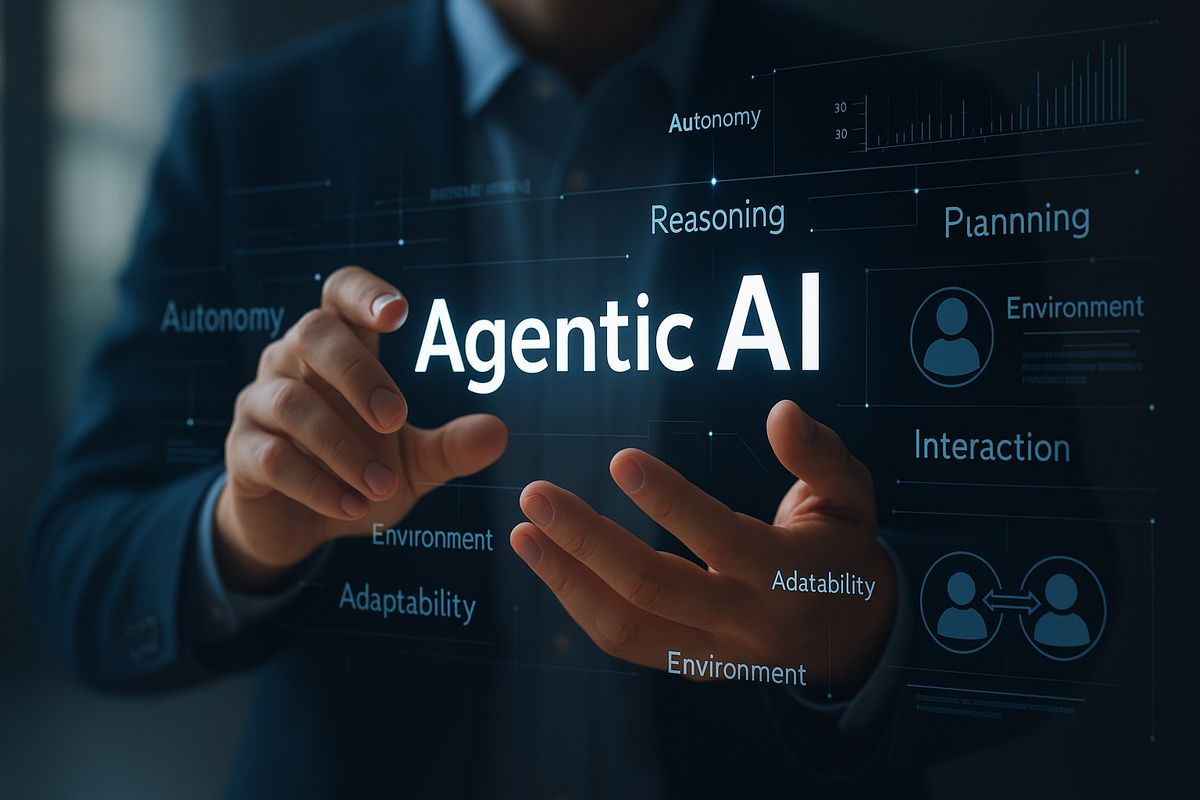
AI is moving beyond chatbots and one-off prompts. Agentic workflows are emerging as a new way to build software around AI systems that can understand goals, plan multi-step tasks, use tools, make decisions, and take action with varying levels of human oversight. The opportunity is significant—but so are the engineering challenges. Successful agentic systems require more than a powerful model. They need reliable tools, clear boundaries, strong observability, permissions, evaluation, and carefully designed human-in-the-loop controls.
Why Agentic Workflows Matter
Traditional software generally follows explicitly programmed paths:
Input
  ↓
Rule
  ↓
Action
  ↓
Output
For example:
New Support Ticket
      ↓
Check Category
      ↓
Assign Team
      ↓
Send Notification
Every decision is predefined.
AI introduces a different possibility.
Instead of defining every individual step, a system can be given a goal:
Investigate this customer issue and determine the next appropriate action.
The system can then:
Goal
 ↓
Understand Context
 ↓
Plan
 ↓
Use Tools
 ↓
Observe Results
 ↓
Adjust Plan
 ↓
Take Action
This is the foundation of an agentic workflow.
The important shift is from:
Software that follows a fixed sequence
to:
Software that can dynamically determine the next step within defined boundaries.
What Makes a Workflow Agentic?
Not every AI-powered workflow is an agent.
A system that simply summarizes a document is an AI feature.
A system that:
1. Reads a document
2. Identifies missing information
3. Searches an internal knowledge base
4. Calls another system
5. Evaluates the result
6. Requests approval
7. Updates a record
8. Reports the outcome
is much closer to an agentic workflow.
A simplified architecture looks like:
                  Goal
                   ↓
                Agent
                   │
          ┌────────┼────────┐
          ▼        ▼        ▼
       Reason     Tools    Context
          │        │        │
          └────────┼────────┘
                   ▼
                 Action
                   ↓
                Result
                   ↓
                Re-plan
The agent is not simply generating text.
It is participating in a controlled execution loop.
From Chatbots to Action-Oriented Systems
The evolution can be thought of in stages.
Stage 1: Traditional Software
Input → Rules → Output
Stage 2: AI Assistant
Input → Model → Response
Stage 3: AI Workflow
Input
 ↓
AI
 ↓
Structured Action
 ↓
Application
Stage 4: Agentic Workflow
Goal
 ↓
Plan
 ↓
Tool
 ↓
Observe
 ↓
Reason
 ↓
Tool
 ↓
Observe
 ↓
Complete
This does not mean agents should operate without constraints.
Quite the opposite.
The more autonomy a system receives, the more important its boundaries become.
Anatomy of an Agentic Workflow
A production agent typically has several components.
                    User Goal
                       │
                       ▼
                  Agent Runtime
                       │
        ┌──────────────┼──────────────┐
        ▼              ▼              ▼
      Model           Tools         Context
        │              │              │
        └──────────────┼──────────────┘
                       ▼
                    Action
                       │
                       ▼
                   External
                    Systems
                       │
                       ▼
                    Result
                       │
                       └──────→ Agent
Model
Provides reasoning, language understanding, and decision support.
Tools
Allow the agent to interact with the real world.
Examples include:
APIs
Databases
Search
CRMs
Ticketing systems
Cloud platforms
Internal services
Context
Provides the information required to make useful decisions.
Runtime
Controls execution, retries, state, permissions, and workflow progression.
The model is only one part of the system.
That distinction is critical.
An agentic application is an engineered system around a model—not merely a model with a prompt.
Where Agentic Workflows Create Real Value
Agentic workflows are particularly interesting when the work contains multiple steps and requires some degree of judgment.
Customer Operations
An agent can:
Customer Request
      ↓
Understand Issue
      ↓
Retrieve Account
      ↓
Check History
      ↓
Identify Resolution
      ↓
Update System
      ↓
Respond
Instead of simply generating a response, the system can complete the operational workflow.
Software Engineering
An engineering agent might:
Issue
 ↓
Inspect Repository
 ↓
Understand Code
 ↓
Implement Change
 ↓
Run Tests
 ↓
Analyze Failures
 ↓
Modify Code
 ↓
Run Tests Again
 ↓
Create Pull Request
Human engineers can then review the resulting change.
Finance Operations
An agent could help process:
Invoices
Expense exceptions
Reconciliation tasks
Financial reports
A workflow might look like:
Invoice
 ↓
Extract Data
 ↓
Validate
 ↓
Match Purchase Order
 ↓
Detect Exception
 ↓
Route for Approval
The important part is that the system can dynamically determine what needs to happen next.
Legal Operations
An agent can assist with:
Contract review
Clause identification
Document retrieval
Policy comparison
Approval routing
For high-impact decisions, human review should remain explicit.
Designing Reliable Agent Loops
Agentic systems can fail in ways traditional applications do not.
An agent may:
Choose the wrong tool
Misinterpret context
Repeat an action
Make an incorrect assumption
Follow an irrelevant path
A reliable architecture therefore places controls around the model.
A basic loop is:
Goal
 ↓
Plan
 ↓
Action
 ↓
Observe
 ↓
Validate
 ↓
Continue / Stop
The validate step is particularly important.
Do not assume that because the model generated an action, the action is correct.
For example:
Agent
 ↓
"Send refund"
 ↓
Policy Check
 ↓
Approved?
 ├── Yes → Execute
 └── No  → Human Review
This turns the model into a decision-making component inside a controlled system.
Tools, APIs, and Enterprise Systems
Agents become genuinely useful when they can interact with existing systems.
Imagine an operations agent with access to:
CRM
 │
Ticketing
 │
Email
 │
Knowledge Base
 │
Analytics
 │
Billing
The agent can coordinate these systems instead of requiring employees to switch between them manually.
But tool design matters.
A tool should have:
A clear purpose
Strict input validation
Explicit permissions
Predictable outputs
For example, instead of giving an agent unrestricted database access:
Agent
  ↓
Raw Database
provide a controlled interface:
Agent
  ↓
getCustomerOrders(customerId)
  ↓
Approved Data
This reduces the blast radius of incorrect decisions.
Give agents capabilities, not unrestricted access.
Memory and Context Management
Agentic workflows often require context across multiple steps.
For example:
Task
 ↓
Step 1
 ↓
Step 2
 ↓
Step 3
 ↓
Final Result
The system needs to know what has already happened.
But simply placing every previous interaction into a giant context window is inefficient.
Modern architectures can separate:
Short-term execution state
Long-term knowledge
User preferences
Task history
External source data
Conceptually:
                 Agent
                   │
        ┌──────────┼──────────┐
        ▼          ▼          ▼
   Task State   Knowledge   History
        │          │          │
        └──────────┼──────────┘
                   ▼
                Context
Good context engineering is often more important than adding another model.
The agent needs the right information, not necessarily more information.
Human-in-the-Loop Controls
Autonomy should be proportional to risk.
A useful model is:
Low Risk
   ↓
Fully Automated

Medium Risk
   ↓
Automated + Review

High Risk
   ↓
Human Approval Required
For example:
Low Risk
Create an internal summary.
Agent → Generate → Store
Medium Risk
Send a customer communication.
Agent → Draft → Human Review → Send
High Risk
Approve a financial transaction.
Agent → Recommend → Human Approval → Execute
This allows organizations to benefit from automation without handing critical decisions entirely to an AI system.
The goal should be controlled autonomy, not maximum autonomy.
Security and Permissions
Agentic systems create a new security challenge.
Traditional applications typically execute predefined actions.
Agents can dynamically decide which available tools to call.
That means permissions become critical.
A secure architecture should enforce:
Identity
Authorization
Least privilege
Tool-level permissions
Data access controls
Audit logs
For example:
Agent
 ↓
Permission Check
 ↓
Tool
 ↓
Policy Check
 ↓
External System
Do not rely on the model itself to enforce security.
A prompt such as:
"Never access confidential customer information."
is not a security boundary.
The actual system must enforce the restriction.
Observability and Evaluation
Traditional applications can often be debugged by following a known execution path.
Agentic systems are less deterministic.
Two executions may take different paths to reach the same result.
That makes observability essential.
Capture:
Prompt / model version
Tool calls
Arguments
Tool results
Execution steps
Latency
Token usage
Errors
Human approvals
Final outcome
A useful trace might look like:
Task Started
   ↓
Model Decision
   ↓
Tool: SearchCustomer
   ↓
Result
   ↓
Model Decision
   ↓
Tool: CreateTicket
   ↓
Approval Required
   ↓
Human Approved
   ↓
Task Completed
This makes agent behavior inspectable.
Evaluation should also go beyond asking:
"Did the answer sound good?"
Measure:
Task completion
Tool accuracy
Error rate
Policy violations
Escalation rate
Cost per task
Time to completion
Human intervention
Common Agentic AI Mistakes
Giving Agents Too Much Autonomy
More autonomy does not automatically produce more value.
Exposing Too Many Tools
A toolset with dozens of overlapping capabilities can confuse the model and increase execution risk.
Treating Prompts as Security Controls
Security must be enforced outside the model.
Skipping Deterministic Validation
Critical actions should pass through normal application rules.
Building Agents Before Fixing Data Access
An agent cannot reliably reason over incomplete or inconsistent enterprise data.
Creating Infinite Loops
Every agent workflow needs:
Maximum steps
Timeouts
Retry limits
Budget controls
Termination conditions
Ignoring Cost
Agentic workflows can make multiple model and tool calls for a single task.
Track cost per completed workflow—not just cost per API call.
Measuring Only Model Quality
The best model can still produce a poor application if the tools, context, permissions, or workflow are badly designed.
A Practical Adoption Strategy
Step 1: Find a Workflow, Not a Chatbot Idea
Start with a process that already has measurable business value.
For example:
Resolve common customer support requests.
Not:
"Let's build an AI agent."
Step 2: Map the Existing Process
Document:
Trigger
 ↓
Decision
 ↓
System
 ↓
Action
 ↓
Approval
 ↓
Outcome
Identify which steps are deterministic and which require judgment.
Step 3: Automate the Deterministic Parts First
Let software handle:
Validation
Data retrieval
Routing
Formatting
Notifications
Step 4: Introduce AI Where Judgment Helps
Use the model for:
Classification
Planning
Summarization
Information retrieval
Recommendation
Step 5: Wrap Every Action With Controls
For each tool define:
Who can use it
What inputs are allowed
What it can change
What validation is required
Step 6: Add Human Approval
Start conservatively.
Agent
 ↓
Recommendation
 ↓
Human Approval
 ↓
Action
Increase autonomy only when the system demonstrates reliability.
Step 7: Build Full Observability
Trace every meaningful agent execution.
Step 8: Measure Business Outcomes
Track:
Time saved
Tasks completed
Error rates
Human intervention
Cost
Customer satisfaction
The goal is not:
"We deployed an agent."
The goal is:
"This workflow now produces better outcomes with less manual effort."
The Future of Agentic Workflows
Agentic systems are likely to evolve from isolated assistants into coordinated layers across enterprise software.
A future architecture might look like:
                     User / Business Goal
                              │
                              ▼
                       Agentic Runtime
                              │
          ┌───────────────────┼───────────────────┐
          ▼                   ▼                   ▼
      Planning             Memory              Policies
          │                   │                   │
          └───────────────────┼───────────────────┘
                              ▼
                         Tool Layer
                              │
        ┌─────────────┬───────┼────────┬─────────────┐
        ▼             ▼       ▼        ▼             ▼
       CRM          ERP     APIs    Databases     SaaS
Instead of employees manually coordinating dozens of systems, agents can become an orchestration layer.
But enterprise adoption will depend heavily on governance.
Organizations will need:
Agent registries
Permission frameworks
Evaluation systems
Audit trails
Model governance
Human approval policies
Cost controls
Incident response
The future is therefore unlikely to be:
"Agents everywhere with unlimited autonomy."
It is more likely to be:
"Agents operating inside carefully engineered boundaries."
Making the Call
Before building an agentic workflow, ask:
What business problem are we solving?

What parts of the workflow actually require reasoning?

Which actions can be deterministic?

What tools does the agent need?

What data can it access?

What actions require approval?

What happens when the model is wrong?

How will we detect failures?

What is the maximum acceptable cost per task?

Can the workflow be safely stopped or rolled back?
Most importantly:
Are we giving AI autonomy because the workflow genuinely benefits from dynamic decision-making—or because "agentic" is currently the fashionable way to describe automation?
That distinction matters.
Final Takeaway
Agentic workflows represent a meaningful evolution in application architecture.
The progression looks like:
Traditional Software
        ↓
AI Assistance
        ↓
AI-Powered Workflows
        ↓
Agentic Execution
        ↓
Controlled Autonomous Systems
The opportunity is enormous.
Agents can coordinate systems, perform multi-step tasks, adapt to changing information, and reduce the amount of repetitive work humans perform.
But reliable agentic systems are not created by simply connecting a model to a few APIs.
They require:
Clear goals
Well-designed tools
Reliable context
Strict permissions
Deterministic validation
Human oversight
Observability
Evaluation
Cost controls
Failure handling
The most successful organizations will treat agents as production software, not experimental chat interfaces.
The real breakthrough is not giving AI the ability to act. It is giving AI the ability to act safely, measurably, and within boundaries that humans can understand and control.
Start with one valuable workflow.
Give the agent only the tools it needs.
Keep high-impact decisions behind appropriate approvals.
Trace every important action.
Measure outcomes instead of demos.
And increase autonomy only as reliability is demonstrated.
The future of AI is moving from answering questions to completing work. The organizations that benefit most will be the ones that build the guardrails, infrastructure, and operational discipline required to let agents do that work responsibly.
Frequently Asked Questions
Need a product built?
We build custom software, mobile apps, and web platforms for startups and enterprises.



Their team became an extension of ours — within months they'd rebuilt our entire product experience from the ground up.