
Mastering ZIO for Pure Functional Backends: Building Reliable, Composable, and Production-Ready Scala Services
ZIO brings a functional approach to backend development by treating effects, failures, dependencies, concurrency, and resource management as explicit parts of the program.


Article Contents
- •Why Pure Functional Backends Matter
- •What ZIO Actually Solves
- •Understanding Effects in ZIO
- •Success, Failure, and Explicit Error Models
- •Fibers and Structured Concurrency
- •Resource Safety
- •Dependency Injection with ZLayer
- •Designing Functional Service Boundaries
- •Working with Databases and External APIs
- •Configuration and Environment Management
- •Testing ZIO Applications
- •Observability and Production Reliability
- •Performance and Scalability
- •Common ZIO Mistakes
- •A Modern ZIO Backend Architecture
- •How to Build a ZIO Service Step by Step
- •When ZIO Makes Sense
- •Making the Call
- •Final Takeaway
Backend systems are becoming increasingly concurrent, distributed, and failure-prone. Database calls time out, external APIs return unexpected responses, messages arrive more than once, and production workloads rarely behave like development environments. ZIO brings a functional approach to these problems by treating effects, failures, dependencies, concurrency, and resource management as explicit parts of the program. Instead of hiding operational behavior inside scattered callbacks and global state, ZIO gives Scala teams a structured way to model what a service does—and under which conditions it can fail. The result is backend code that can be easier to compose, test, reason about, and operate. But mastering ZIO requires more than learning `ZIO`, `ZLayer`, and fibers. The real skill is learning how to design application boundaries so functional effects remain useful rather than becoming another layer of accidental complexity.
Why Pure Functional Backends Matter
Modern backend services are not simply functions that receive requests and return responses.
A real service might need to:
Receive Request
      ↓
Authenticate
      ↓
Validate
      ↓
Query Database
      ↓
Call External API
      ↓
Publish Event
      ↓
Return Response
Every step can fail.
The database may be unavailable.
The external API may timeout.
The event broker may reject a message.
The request may be invalid.
The service may need to perform several operations concurrently.
Traditional imperative code often handles these concerns through:
Exceptions
Mutable state
Callbacks
Global dependencies
Ad hoc thread management
As the application grows, the operational behavior becomes difficult to see.
Functional programming takes a different approach.
Instead of executing effects immediately, the program describes them.
Description of Work
       ↓
Composition
       ↓
Execution
ZIO is designed around this model.
What ZIO Actually Solves
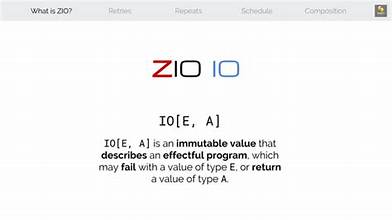
ZIO is a Scala library for building asynchronous, concurrent, and resource-safe applications using functional programming.
Its central abstraction is an effect:
ZIO[R, E, A]Conceptually, this means:
R → Environment / Dependencies
E → Possible Failure
A → Successful Result
So a ZIO effect describes:
A computation that requires `R`, may fail with `E`, and may produce `A`.
For example:
ZIO[
  Database,
  DatabaseError,
  User
]
This communicates far more information than a method returning simply:
UserThe type tells you that the operation:
Needs a database
Can fail
Produces a user
That explicitness is one of ZIO's most powerful ideas.
Understanding Effects in ZIO
An effect is a description of work.
Consider:
Read User
   ↓
Validate User
   ↓
Save User
Rather than executing each operation immediately, ZIO allows you to compose them into a larger effect:
Read
 ↓
Validate
 ↓
Save
 ↓
Combined Effect
The resulting program can then be executed by the ZIO runtime.
This separation is important.
You can build:
Business Logic
      ↓
Pure / Composable Effects
      ↓
Runtime
The runtime handles execution concerns such as:
Concurrency
Scheduling
Fiber management
Cancellation
Resource handling
The application describes what should happen.
ZIO manages much of how that work runs.
Success, Failure, and Explicit Error Models
Traditional Scala applications often rely heavily on exceptions.
For example:
try
  Database Operation
catch
  Exception
This can make failure paths difficult to understand.
ZIO encourages explicit failure modeling.
Conceptually:
ZIO[R, UserNotFound, User]The failure type becomes part of the program's interface.
That means callers can reason about:
Success
  ↓
User

Failure
  ↓
UserNotFound
Instead of discovering possible failures by reading implementation details.
This is particularly useful in business applications where errors are part of normal control flow.
For example:
UserNotFound
InvalidOrder
PaymentRejected
DatabaseUnavailable
are fundamentally different from unexpected programming failures.
A good ZIO design makes those distinctions explicit.
Error Modeling: Business Failures vs. Defects
Not every failure should be treated the same way.
A useful conceptual distinction is:
Failure
├── Expected Business Error
│     ├── InvalidInput
│     ├── NotFound
│     └── Unauthorized
│
└── Unexpected Defect
      ├── Programming Bug
      └── Broken Invariant
Expected failures can often be modeled directly in the application's error algebra.
Unexpected defects should generally remain visible rather than being quietly converted into ordinary business errors.
This makes production failures easier to diagnose.
Fibers and Structured Concurrency
Concurrency is one of ZIO's strongest capabilities.
Instead of manually managing threads, ZIO uses lightweight fibers.
Conceptually:
Application
    │
    ├── Fiber A
    ├── Fiber B
    └── Fiber C
Fibers are significantly lighter than operating-system threads.
This makes it practical to run many concurrent operations.
For example:
Request
  │
  ├── Fetch Customer
  ├── Fetch Orders
  └── Fetch Recommendations
          │
          ▼
      Combine Results
If these operations are independent, they can be performed concurrently.
The architecture becomes:
              Request
                 │
        ┌────────┼────────┐
        ▼        ▼        ▼
     Customer  Orders  Recommendations
        │        │        │
        └────────┼────────┘
                 ▼
              Response
This can reduce latency without requiring developers to manually coordinate threads.
Structured Concurrency
One of the most important ideas in modern concurrent programming is that spawned work should have a clear lifetime.
Imagine:
Request
   ↓
Spawn Task
   ↓
Request Completes
   ↓
Task Still Running
That can create resource leaks and unpredictable behavior.
Structured concurrency instead creates a relationship:
Parent Scope
    │
    ├── Child Fiber
    ├── Child Fiber
    └── Child Fiber
When the parent scope ends, child work can be managed according to explicit lifecycle rules.
This makes concurrent systems easier to reason about.
Resource Safety
Backend applications constantly acquire resources:
Database connections
HTTP connections
Files
Sockets
Locks
Thread pools
A common problem in imperative code is forgetting to release something when an operation fails.
ZIO provides resource-management abstractions designed to make acquisition and release composable.
The conceptual lifecycle is:
Acquire
  ↓
Use
  ↓
Release
Even if the operation fails:
Acquire
  ↓
Use
  ↓
Failure
  ↓
Release
This is critical for long-running backend services.
Resource management should not depend on developers remembering every cleanup path manually.
Dependency Injection with ZLayer
One of ZIO's most distinctive features is `ZLayer`.
Instead of creating dependencies globally:
Global Database
Global Config
Global Client
dependencies can be modeled explicitly.
Conceptually:
Application
   │
   ├── Database
   ├── Configuration
   └── External API Client
A layer describes how to construct services required by the application.
For example:
Configuration
      ↓
Database
      ↓
UserRepository
      ↓
UserService
      ↓
HTTP API
This creates a dependency graph.
The application declares what it needs.
The runtime assembles the required environment.
Why ZLayer Matters
The benefit is not simply dependency injection.
It is explicit dependency composition.
Consider testing.
Production:
UserService
   ↓
Real Database
Test:
UserService
   ↓
In-Memory / Mock Database
The business logic can remain unchanged.
This dramatically improves testability.
It also reduces the need for:
Global singletons
Hidden dependencies
Manual wiring
Environment-specific conditionals
Designing Functional Service Boundaries
A scalable ZIO application should not become one enormous effect.
Organize the application around business capabilities.
For example:
Application
│
├── UserService
├── OrderService
├── PaymentService
└── NotificationService
Each service can define a focused interface.
Conceptually:
OrderService
   │
   ├── createOrder
   ├── getOrder
   └── cancelOrder
Then implementation details remain behind the boundary:
OrderService
     ↓
OrderRepository
     ↓
Database
This allows business logic to remain independent from infrastructure details.
Keep Business Logic Separate From Infrastructure
A useful architecture is:
                API Layer
                    ↓
              Application Layer
                    ↓
              Domain Logic
                    ↓
        ┌───────────┼───────────┐
        ▼           ▼           ▼
    Database      HTTP       Messaging
The domain should not need to know how the database connection is configured.
It should know what operation it needs.
For example:
OrderService
    ↓
OrderRepository
rather than:
OrderService
    ↓
PostgreSQL Driver
    ↓
Connection Pool
    ↓
SQL
This separation improves portability and testing.
Working With Databases
Database operations are naturally effectful.
A typical flow might be:
HTTP Request
    ↓
OrderService
    ↓
OrderRepository
    ↓
Database
    ↓
Result
The repository should expose domain-oriented operations where practical.
For example:
findOrder
createOrder
updateOrder
rather than leaking database implementation details into business logic.
Error handling should also remain explicit.
Database Failure
      ↓
Repository Error
      ↓
Service Error
      ↓
API Response
This allows infrastructure failures to be translated into appropriate application-level behavior.
External APIs and Timeouts
Distributed systems fail.
An external API can:
Timeout
Return invalid data
Return a server error
Rate-limit requests
Become temporarily unavailable
A functional backend should make these possibilities explicit.
For example:
Service
  ↓
HTTP Client
  ↓
Timeout
  ↓
Recover / Retry / Fail
Retries should be deliberate.
Retrying every failure can make an outage worse.
A more thoughtful strategy considers:
Retryable errors
Maximum attempts
Backoff
Jitter
Timeouts
Circuit-breaking behavior
ZIO's composable effect model makes these policies easier to express as reusable building blocks.
Configuration and Environment Management
Production applications have configuration such as:
Database URLs
API credentials
Timeouts
Feature flags
Service endpoints
Avoid scattering configuration across the application.
A cleaner model is:
Configuration
      ↓
Application Environment
      ↓
Services
This makes environment differences explicit.
For example:
Development
   ↓
Local Database

Testing
   ↓
Test Database

Production
   ↓
Managed Database
The business logic remains unchanged.
Only the environment changes.
Testing ZIO Applications
Functional architecture can make testing significantly cleaner.
A useful test looks like:
Input
  ↓
Service
  ↓
Expected Result
Instead of needing to configure an entire application.
Because dependencies can be provided through layers, tests can substitute implementations.
For example:
Production
   ↓
Real Database

Test
   ↓
Test Database
This allows tests to focus on behavior.
Important test categories include:
Unit tests
Integration tests
Property-based tests
API tests
Database tests
Failure-path tests
Do not test only the happy path.
Functional backends should test failure behavior deliberately.
Testing Concurrency
Concurrency bugs are notoriously difficult to reproduce.
ZIO's model makes concurrency explicit enough to test many scenarios systematically.
For example:
Task A
   │
Task B
   │
Task C
   │
   ▼
Combined Result
Tests can verify:
Timeout behavior
Cancellation
Parallel execution
Resource cleanup
Failure propagation
This is especially important for high-throughput backend services.
Observability and Production Reliability
Pure functional programming does not remove operational complexity.
Production systems still need:
Logs
Metrics
Tracing
Health checks
Error reporting
A modern ZIO service should make observability part of the architecture.
Conceptually:
Request
  ↓
Service
  ↓
Database / External API
  ↓
Metrics + Logs + Traces
A useful production trace might tell you:
Request
 ↓
UserService
 ↓
Database Query
 ↓
Payment API
 ↓
Response
This becomes extremely valuable when debugging latency or failures across distributed systems.
Performance and Scalability
ZIO is designed for high-concurrency applications.
Fibers provide lightweight concurrency, while the runtime manages execution.
But good performance still requires good architecture.
Watch for:
Slow database queries
Excessive allocations
Blocking operations
Large payloads
Unbounded concurrency
Unnecessary network calls
One particularly important issue is blocking work.
A backend should distinguish between:
Non-Blocking Work
       ↓
ZIO Runtime
and:
Blocking I/O
       ↓
Dedicated Blocking Executor
Database and file operations often require careful treatment.
The runtime should not be allowed to stall because blocking work consumes the wrong execution resources.
Backpressure and Concurrency Limits
More concurrency is not always better.
Suppose a service receives:
10,000 Requests
      ↓
10,000 Database Queries
The database may collapse under the load.
Instead, the system should establish reasonable limits:
10,000 Requests
      ↓
Concurrency Limit
      ↓
Controlled Database Load
This is where concepts such as:
Semaphores
Queues
Bounded concurrency
Rate limits
become important.
The goal is not maximum concurrency.
The goal is sustainable throughput.
Common ZIO Mistakes
Treating Every Effect as Business Logic
Effects should be organized around meaningful application boundaries.
Overusing Layers
ZLayer is powerful, but excessive abstraction can make a small application difficult to understand.
Use layers where dependency composition provides real value.
Hiding Errors
Do not catch every failure and convert it into a generic error.
Preserve useful error information.
Ignoring Blocking Operations
Blocking I/O can undermine concurrency if it runs on inappropriate execution resources.
Creating Giant Services
A UserService containing authentication, billing, notifications, analytics, and reporting is still a monolith.
Making Everything Concurrent
Parallel execution is useful only when operations are independent and the underlying systems can handle the load.
Overusing unsafeRun
Application code should generally describe effects.
The runtime should execute them at the appropriate boundary.
A Modern ZIO Backend Architecture
A scalable service can look like:
                         HTTP / Messaging
                               │
                               ▼
                         API / Adapter
                               │
                               ▼
                         Application Layer
                               │
             ┌─────────────────┼─────────────────┐
             ▼                 ▼                 ▼
        User Service      Order Service     Payment Service
             │                 │                 │
             └─────────────────┼─────────────────┘
                               ▼
                       Infrastructure Layer
                               │
             ┌─────────────────┼─────────────────┐
             ▼                 ▼                 ▼
         Database          HTTP Client        Message Bus
The dependency graph can then be assembled through layers:
Config
  ↓
Database
  ↓
Repositories
  ↓
Domain Services
  ↓
API
This creates a clean separation between:
Business behavior
Infrastructure
Runtime configuration
External systems
How to Build a ZIO Service Step by Step
Step 1 — Define the Domain
Start with the business capability.
For example:
Order ManagementDefine the operations the application needs.
Step 2 — Model Errors Explicitly
Identify expected failures:
OrderNotFound
InvalidOrder
PaymentRejected
Avoid using generic exceptions for normal business outcomes.
Step 3 — Define Service Interfaces
Keep the API focused.
OrderService
 ├── create
 ├── get
 └── cancel
Step 4 — Separate Infrastructure
Define repository and client boundaries.
OrderService
   ↓
OrderRepository
   ↓
Database
Step 5 — Compose Dependencies
Use ZLayer to assemble the application environment.
Step 6 — Add Concurrency Deliberately
Identify operations that can safely run in parallel.
Step 7 — Add Resource Management
Make database pools, clients, and other resources lifecycle-aware.
Step 8 — Build Failure Paths
Test:
Timeouts
Unavailable dependencies
Invalid requests
Database failures
Cancellation
Step 9 — Add Observability
Instrument the important application boundaries.
Step 10 — Measure in Production
Monitor:
Latency
Throughput
Error rates
Resource utilization
Dependency health
When ZIO Makes Sense
ZIO is particularly compelling for teams building:
High-concurrency services
Distributed systems
Data-processing pipelines
Event-driven applications
Financial services
Infrastructure platforms
Backend APIs with complex failure handling
Systems requiring strong resource management
It is especially valuable when the team appreciates functional programming and wants effects, dependencies, and failures to be explicit.
When ZIO May Be Too Much
Not every Scala application needs ZIO.
A small service with:
Simple CRUD
Limited concurrency
Minimal infrastructure
may not benefit enough to justify introducing a sophisticated effect system.
Likewise, if a team is unfamiliar with functional programming, adopting ZIO without investing in training can create unnecessary friction.
The right question is not:
Is ZIO powerful?
It clearly is.
The question is:
Does our application's complexity justify the abstraction?
Making the Call
Engineering leaders evaluating ZIO should ask:
How much concurrency does the system need?
How important are explicit failure and resource-management guarantees?
Do we need dependency composition that is easy to replace in tests?
Are our services becoming difficult to reason about because of asynchronous workflows?
Does the team have the Scala and functional-programming experience required to use ZIO effectively?
Would ZIO simplify the architecture—or simply add another abstraction layer?
Most importantly:
Are we adopting functional programming to solve a real engineering problem?
That is the deciding factor.
Final Takeaway
Mastering ZIO is not about learning a collection of APIs.
It is about changing how backend systems are modeled.
Instead of:
Code
 ↓
Threads
 ↓
Exceptions
 ↓
Global Dependencies
 ↓
Cleanup
the architecture becomes:
Effect
 ↓
Composition
 ↓
Explicit Failure
 ↓
Explicit Dependencies
 ↓
Managed Resources
 ↓
Runtime
ZIO gives developers powerful abstractions for:
Effects
Concurrency
Cancellation
Resource safety
Dependency management
Error handling
Testing
These capabilities become especially valuable as backend systems become more distributed and operationally complex.
But the best ZIO code is not the code that uses every feature.
It is the code where the abstractions make the system easier to understand.
Pure functional programming is most valuable when it turns hidden complexity into explicit structure.
A well-designed ZIO backend makes it clear:
What the service needs
What it can fail with
What resources it owns
What work can run concurrently
How dependencies are assembled
How failures propagate
How the system behaves under load
That clarity is the real payoff.
ZIO does not eliminate backend complexity. It gives teams a disciplined way to model that complexity so it can be composed, tested, and controlled.
For modern Scala teams building reliable services, that can be a powerful advantage: fewer hidden side effects, safer concurrency, clearer dependencies, and a backend architecture where operational behavior is part of the design rather than something discovered after production breaks.
Frequently Asked Questions
Need a product built?
We build custom software, mobile apps, and web platforms for startups and enterprises.



Their team became an extension of ours — within months they'd rebuilt our entire product experience from the ground up.