Eliminating Technical Debt with Flow Designer: Modernizing Enterprise Workflows Without Rebuilding Everything
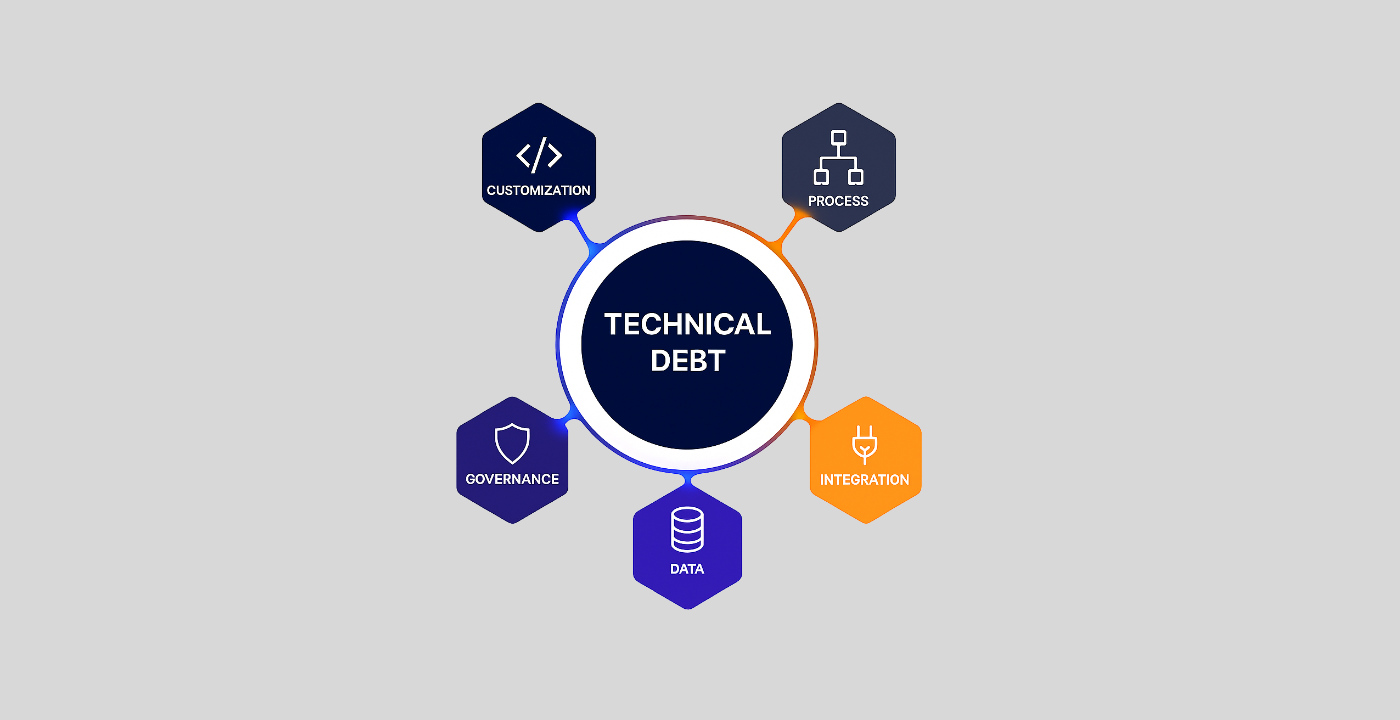
Technical debt is rarely created by one bad decision. It accumulates quietly through manual approvals, duplicated workflows, outdated scripts, disconnected systems, brittle integrations, and business processes that once made sense but no longer fit how the organization operates.


Article Contents
- •Why Technical Debt Hides Inside Workflows
- •What Flow Designer Changes
- •Technical Debt vs. Operational Debt
- •Finding the Highest-Value Automation Opportunities
- •Replacing Legacy Workflow Logic
- •Designing Maintainable Flows
- •Subflows and Reusable Automation
- •Events, Triggers, and Actions
- •Integrating External Systems
- •Managing Errors and Failures
- •Security and Governance
- •Testing and Deployment
- •Measuring Technical Debt Reduction
- •Common Flow Designer Mistakes
- •A Modern Flow Designer Architecture
- •How to Modernize Legacy Workflows
- •When Flow Designer Makes Sense
- •Making the Call
- •Final Takeaway
Technical debt is rarely created by one bad decision. It accumulates quietly through manual approvals, duplicated workflows, outdated scripts, disconnected systems, brittle integrations, and business processes that once made sense but no longer fit how the organization operates. The problem is that technical debt eventually becomes operational debt: teams spend more time maintaining workflows than improving them, employees work around system limitations, and every new change becomes harder to deliver safely. Flow Designer provides a modern way to tackle this problem by replacing fragmented automation with reusable, visible, event-driven workflows. Instead of treating technical debt as a giant rewrite project, organizations can use Flow Designer to systematically identify repetitive work, consolidate legacy automation, standardize business logic, and create workflows that are easier to understand and maintain.
Why Technical Debt Hides Inside Workflows
Technical debt is often associated with old code.
But enterprise platforms accumulate technical debt in many other places.
Consider a process like:
Employee Request
      ↓
Email
      ↓
Manual Review
      ↓
Spreadsheet
      ↓
Script
      ↓
Another System
      ↓
Manual Update
It may technically work.
But every additional step creates another maintenance point.
Over time, organizations can accumulate:
Legacy workflows
Business rules
Scheduled jobs
Custom scripts
Email notifications
Manual approvals
Point-to-point integrations
Duplicated automation
The result becomes difficult to understand.
A team may know that:
This process works.
But nobody can confidently answer:
Why does it work this way?
That is a classic sign of technical debt.
What Flow Designer Changes
Flow Designer provides a visual and structured approach to creating workflows and automation.
Instead of hiding process logic across multiple scripts and configuration records, a workflow can be represented more clearly:
Trigger
  ↓
Get Data
  ↓
Validate
  ↓
Decision
  ↓
Action
  ↓
Notification
This makes the process easier to inspect.
More importantly, it allows organizations to move toward reusable automation.
For example:
New Request
    ↓
Approval Flow
    ↓
Notification
    ↓
Task Creation
can become a standardized building block rather than something recreated independently by every team.
Technical Debt vs. Operational Debt
Technical debt often begins as a technical shortcut.
But its consequences eventually appear in day-to-day operations.
For example:
Legacy Script
     ↓
Hard to Modify
     ↓
Manual Workaround
     ↓
Longer Processing Time
     ↓
Employee Frustration
That is where technical debt becomes operational debt.
Examples include:
Employees manually entering the same information twice
Approvals handled through email
Teams maintaining spreadsheets outside the platform
Support staff manually synchronizing records
Developers afraid to change old workflows
Business processes depending on one person who understands the legacy implementation
Flow Designer can help address the technical root cause behind these operational problems.
Finding the Highest-Value Automation Opportunities
Do not start by migrating every workflow.
Start with the processes that create the most friction.
Look for workflows that are:
Frequently executed
Highly repetitive
Manual
Error-prone
Business-critical
Difficult to modify
Dependent on legacy scripts
A useful prioritization model is:
Business Impact
      ×
Maintenance Cost
      ×
Change Frequency
      ↓
Migration Priority
For example:
| Workflow | Frequency | Complexity | Risk | Priority |
|---|---|---|---|---|
| Employee onboarding | High | Medium | High | High |
| Password reset | High | Low | Medium | High |
| Annual report | Low | High | Medium | Medium |
| Legacy notification | Medium | Low | Low | Medium |
The objective is not to modernize everything.
It is to modernize the workflows that create meaningful value.
Replacing Legacy Workflow Logic
Many organizations have accumulated multiple generations of automation.
You may find:
Legacy Workflow
     +
Business Rule
     +
Script
     +
Scheduled Job
     +
Email Notification
all contributing to the same business process.
That makes debugging difficult.
A modernization effort can consolidate these pieces:
Event
  ↓
Flow Designer
  ↓
Decision
  ↓
Reusable Subflow
  ↓
Actions
The goal is not simply to redraw the old workflow visually.
The goal is to understand the original business requirement and simplify the implementation.
Don't Migrate Technical Debt Blindly
A dangerous approach is:
Take every existing workflow and recreate it in Flow Designer.
That can produce:
Old Complexity
      ↓
New Visual Interface
      ↓
Same Complexity
The organization has technically migrated the workflow.
But it has not eliminated the debt.
Before rebuilding a workflow, ask:
Why does this workflow exist?
Is the business requirement still valid?
Can multiple workflows be consolidated?
Can some steps be removed?
Can manual approvals be automated safely?
Does the process still need the same integrations?
Modernization should challenge the process—not simply reproduce it.
Designing Maintainable Flows
A maintainable flow should be easy for another engineer or administrator to understand.
A useful structure is:
Trigger
   ↓
Input Validation
   ↓
Business Decision
   ↓
Reusable Action
   ↓
Outcome
Avoid building enormous flows with dozens of unrelated steps.
If the workflow becomes:
Trigger
 ↓
Step
 ↓
Decision
 ↓
Step
 ↓
Decision
 ↓
Step
 ↓
Decision
 ↓
Step
 ↓
...
it may be time to break the logic into smaller reusable units.
The visual interface should make complexity easier to understand—not simply make a complex system look colorful.
Subflows and Reusable Automation
One of the strongest ways to reduce technical debt is to eliminate duplicated logic.
Suppose five workflows all perform:
Validate Request
     ↓
Create Task
     ↓
Notify Owner
Instead of maintaining five copies:
Flow A ──┐
Flow B ──┤
Flow C ──┼──► Shared Logic
Flow D ──┤
Flow E ──┘
create a reusable subflow.
Then:
Flow A
   ↓
Subflow

Flow B
   ↓
Subflow

Flow C
   ↓
Subflow
Now a change to the common behavior can be made in one place.
This is one of the clearest ways Flow Designer can reduce maintenance overhead.
Events, Triggers, and Actions
A modern workflow architecture should distinguish between:
Trigger
When should the workflow start?
For example:
Record Created
Record Updated
Scheduled Event
External Event
Decision
What should happen under different conditions?
If Approved
    ↓
Continue

If Rejected
    ↓
Stop / Escalate
Action
What should the system do?
Create Record
Update Record
Send Notification
Call Integration
Request Approval
Keeping these responsibilities clear makes workflows easier to reason about.
Integrating External Systems
Technical debt often grows at system boundaries.
A typical enterprise environment might look like:
ServiceNow
    │
    ├── HR System
    ├── Identity Platform
    ├── ERP
    ├── CRM
    └── Messaging Platform
If every integration is custom-built independently:
System A ←→ Custom Script
System B ←→ Custom Script
System C ←→ Custom Script
System D ←→ Custom Script
maintenance becomes expensive.
Flow Designer can provide a more consistent orchestration layer:
Business Event
      ↓
Flow
      ↓
Integration Action
      ↓
External System
      ↓
Response
This can make integration logic more visible and standardized.
But avoid turning Flow Designer into a replacement for every integration platform.
Use the appropriate integration mechanism for the complexity and reliability requirements of the workload.
Error Handling and Failure Paths
A workflow is not production-ready just because the happy path works.
Real systems fail.
External APIs timeout.
Records are missing.
Permissions change.
Approvals expire.
Integrations return unexpected responses.
A robust flow should explicitly account for failure:
Trigger
   ↓
Action
   │
   ├── Success → Continue
   │
   └── Failure → Handle / Retry / Escalate
Possible strategies include:
Retry
Fallback
Notification
Escalation
Compensation
Manual intervention
The correct response depends on the business process.
For example, a failed informational notification may not need the same treatment as a failed financial transaction.
Idempotency Matters
Automation can sometimes execute more than once.
Imagine:
Event
 ↓
Flow
 ↓
External API
If the flow retries after a timeout, the external system might receive the request twice.
For important operations, design workflows so repeated execution does not create unintended results.
For example:
Request ID
   ↓
Check Existing Operation
   ↓
Already Processed?
   ├── Yes → Stop
   └── No → Execute
This is particularly important for:
Payments
Provisioning
Account creation
External updates
Ticket creation
Technical debt often hides in assumptions that "this workflow will only run once."
Production systems are rarely that simple.
Security and Governance
Automation can execute actions with significant privileges.
That makes Flow Designer governance critical.
Define:
Who can create flows?
Who can modify them?
Which integrations can they call?
What credentials are used?
Which records can they access?
How are changes reviewed?
A useful model is:
Developer / Admin
       ↓
Flow Change
       ↓
Review
       ↓
Testing
       ↓
Deployment
Avoid allowing critical production automation to become invisible personal infrastructure owned by one administrator.
Testing and Deployment
Modern workflow automation should follow software-engineering discipline.
A good process looks like:
Design
 ↓
Build
 ↓
Test
 ↓
Review
 ↓
Deploy
 ↓
Monitor
Test:
Trigger conditions
Decision branches
Successful execution
Failure handling
Permissions
Integration responses
Duplicate execution
For critical workflows, test both expected and unexpected paths.
Versioning and Change Management
Technical debt grows when nobody knows why an automation changed.
Document important workflows with:
Purpose
Owner
Dependencies
Trigger
Expected outcomes
Failure behavior
External integrations
For example:
Workflow: Employee Onboarding

Owner: HR Platform Team

Trigger:
New Employee Created

Dependencies:
Identity System
HR System
Notification Service

Failure:
Create Support Task + Alert Owner
This turns tribal knowledge into organizational knowledge.
Observability for Workflow Automation
Automation should be observable.
You need to know:
How often does the flow execute?
How often does it fail?
Where does it fail?
How long does it take?
Which external integration causes failures?
A useful operational model is:
Flow
 │
 ├── Execution Metrics
 ├── Error Logs
 ├── Integration Results
 └── Business Outcome
The goal is to move from:
Someone says the automation isn't working.
to:
The onboarding flow has a 4.2% failure rate, primarily caused by identity-provider timeouts.
That is actionable information.
Common Flow Designer Mistakes
Rebuilding Every Legacy Workflow
Not everything deserves migration.
Some processes should be retired.
Creating Giant Flows
Large visual workflows can become just as difficult to maintain as large scripts.
Duplicating Subflows
If the same logic appears repeatedly, centralize it.
Ignoring Failure Paths
Happy-path automation is not production automation.
Hard-Coding Everything
Avoid embedding values that should be configurable or centrally managed.
Creating Too Many Dependencies
Every external dependency increases operational risk.
No Ownership Model
Every important workflow needs an accountable owner.
Automating Broken Processes
Automation can make a bad process run faster.
It does not automatically make it better.
A Modern Flow Designer Architecture
A scalable automation environment can look like:
                     Business Event
                           │
                           ▼
                       Flow
                           │
              ┌────────────┼────────────┐
              ▼            ▼            ▼
           Decision     Subflow      Integration
              │            │            │
              └────────────┼────────────┘
                           ▼
                     Business Outcome
Supporting the platform:
Security
Governance
Testing
Version Control
Observability
CI/CD
The key principle is separation.
Flows orchestrate.
Subflows encapsulate reusable behavior.
Integrations connect systems.
Business rules remain understandable.
How to Modernize Legacy Workflows
A practical modernization strategy can happen in stages.
Step 1 — Inventory Existing Automation
Create a map of:
Workflows
Business rules
Scripts
Scheduled jobs
Notifications
Integrations
Step 2 — Identify Duplicate Logic
Find processes performing the same work.
Step 3 — Classify Each Workflow
Use categories such as:
Keep
Retire
Simplify
Consolidate
Rebuild
This prevents unnecessary migration.
Step 4 — Prioritize High-Value Debt
Start with workflows that are:
High frequency
High maintenance
Business critical
Error-prone
Step 5 — Redesign Before Rebuilding
Document the desired future process.
Do not blindly copy the legacy implementation.
Step 6 — Extract Reusable Subflows
Centralize common operations.
Step 7 — Add Failure Handling
Define what happens when dependencies fail.
Step 8 — Test and Deploy Incrementally
Move one business process at a time.
Step 9 — Monitor Production
Measure execution and failure behavior.
Step 10 — Retire the Old Automation
This step is critical.
Do not leave the old workflow running "just in case."
Otherwise:
Old Workflow
      +
New Flow
      ↓
Duplicate Automation
      ↓
More Technical Debt
Modernization is incomplete until obsolete automation is removed.
Measuring Technical Debt Reduction
The success of modernization should be measurable.
Track:
Complexity
Number of legacy workflows
Number of custom scripts
Duplicated automation
Unused integrations
Reliability
Flow failure rate
Retry rate
Manual intervention
Production incidents
Productivity
Time to change a workflow
Time to diagnose failures
Deployment frequency
Business Outcomes
Processing time
Manual steps eliminated
Employee effort saved
Customer response time
A particularly useful metric is:
How long does it take to safely change an important business workflow?
If the answer moves from weeks to days—or days to hours—you are seeing the value of reducing technical debt.
When Flow Designer Makes Sense
Flow Designer is particularly valuable when organizations need to:
Modernize legacy workflow automation
Reduce manual processes
Standardize repetitive operations
Connect business systems
Create reusable automation
Improve workflow visibility
Reduce custom scripting
It is especially useful when the organization already relies heavily on ServiceNow and wants to move toward more maintainable platform-native automation.
When Flow Designer Is Not the Answer
Not every problem should become a flow.
Avoid forcing Flow Designer into workloads that require:
Highly complex algorithms
Large-scale data processing
Advanced application logic
Specialized infrastructure
Extreme performance requirements
In those cases, application code or specialized platforms may be more appropriate.
The goal is not:
Put everything into Flow Designer.
The goal is:
Use Flow Designer where workflow orchestration is the right abstraction.
Making the Call
Technology leaders should ask:
Which workflows create the most operational friction?
How much legacy automation do we actually have?
Where is business logic duplicated?
Which scripts are difficult to understand or safely modify?
Which processes are still dependent on manual work?
Can common behavior become reusable subflows?
Do we have clear ownership and governance?
Can we measure failures and business outcomes after modernization?
Most importantly:
Are we eliminating technical debt—or simply moving it into a new visual tool?
That is the question that separates genuine modernization from migration theater.
Final Takeaway
Technical debt does not disappear because an organization adopts a newer automation platform.
It disappears when teams remove unnecessary complexity, consolidate duplicated logic, retire obsolete systems, and create processes that are easier to change safely.
Flow Designer can provide a strong foundation for that transformation.
The modernization path looks like:
Legacy Automation
      ↓
Inventory
      ↓
Simplify
      ↓
Consolidate
      ↓
Flow Designer
      ↓
Reusable Subflows
      ↓
Observable Automation
The strongest implementations follow a few principles:
Do not migrate unnecessary workflows.
Redesign before rebuilding.
Keep flows focused.
Extract reusable subflows.
Design failure paths explicitly.
Secure privileged actions.
Test before deployment.
Monitor production behavior.
Retire obsolete automation.
And most importantly:
Automation should reduce complexity, not hide it.
A modern workflow platform should make it easier to understand how a business process works, who owns it, what happens when something fails, and how safely it can evolve.
That is the real opportunity with Flow Designer.
The goal is not simply to replace old workflows with new workflows. It is to transform a growing collection of fragile automation into a governed, reusable, observable system that can evolve with the business.
When done properly, technical debt reduction becomes more than cleanup.
It becomes a competitive advantage: faster change, fewer manual processes, lower operational risk, and a platform that teams can confidently build on instead of constantly working around.
Frequently Asked Questions
Need a product built?
We build custom software, mobile apps, and web platforms for startups and enterprises.



Their team became an extension of ours — within months they'd rebuilt our entire product experience from the ground up.